AI Engineer World's Fair 2026 — "Software Factories" Mainstage (Day 1)
Video: https://youtu.be/htM02KMNZnk Channel: AI Engineer · Uploaded: 2026-07-01 · Length: 8h 36m (full livestream) Title: WF2026: Software Factories & Keynotes ft. Microsoft, OpenAI, OpenClaw, Z.ai (GLM), MiniMax, HF
Speaker names verified (2026-07-06) against the conference's official open data (
ai.engineer/worldsfair/2026/sessions.json+speakers.json). The stream is the June 30 "Software Factories" keynote track (19 sessions) plus break/lunch filler. Segments below marked ⚠︎ unverified don't map to a scheduled main-stage session (break/expo/filler or caption mis-segmentation) — their content is real but the speaker attribution is uncertain.Summary-only doc: topics · speakers · arguments · quotes · slides.
TL;DR
This is the Day-1 mainstage livestream of the AI Engineer World's Fair 2026. The organizing theme is "Software Factories" — the idea that software engineering is becoming factory engineering: ideas flow in, fleets of agents triage, spec, implement, verify and ship in a continuous loop, and humans supervise at checkpoints. A second, related frame runs through the whole day: "loops" — the core skill of an AI engineer is choosing which loop to operate in and when to move up or down a level.
Across ~30 talks, three things recur so often they are effectively the consensus of the event:
- The model is no longer the bottleneck — the harness, the environment, and human attention are. Talk after talk argues that infrastructure around the agent (sandboxes, memory, retrieval, evals, loops) is where the wins now come from.
- Isolation/sandboxing is treated as table stakes for autonomy. Cloud sandboxes, local containers, per-iteration microVMs, "secure environments," network allowlists, air-gapped execution and human-approval gates appear in a large fraction of talks — usually stated as the precondition for letting agents run unattended.
- Speed without discipline produces "slop." The counter-melody to the factory hype: several speakers (Human Layer, BAML, formal-methods researchers) warn that unreviewed, over-autonomous agents degrade codebases and safety, and that engineering judgment must stay in the loop.
Strikingly, ~20 independent speakers converge on the same claims — with a few pointed disagreements worth noting.
The two meta-frames
"Loops" (Swix's opening). Every capability is a loop: heartbeat → chat → tools → goals → automations/cron. Being an AI engineer = knowing which loop you're in and when to go up (more leverage) or down (more reliability). The conference itself is framed as "the loop that makes loops."
"Software Factories" (the mainstage track). Coined into the day by the track intro and hammered by Warp, Factory, Human Layer, BAML, Conductor and others. A software factory is the full SDLC as an automated, self-improving loop — not a single coding agent. The debate all day is how to build one that ships fast without producing slop.
Talk index
Verified against the official schedule. The 19 rows without ⚠︎ are confirmed main-stage sessions; ⚠︎ marks break/filler segments whose speaker is unverified.
| # | Time | Talk (official title) | Speaker(s) | Org | Rel |
|---|---|---|---|---|---|
| 1 | 00:01 | The Highest Loop | Shawn "swyx" Wang | AI Engineer / Latent Space | · |
| 2 | 00:09 | Software Factories framing | swyx (cont.) | — | ⭐ |
| 3 | 00:11 | On AI and Knowledge | Pablo Castro | Microsoft | ⭐ |
| 4 | 00:29 | The Golden Age of AI Engineering | Romain Huet + Alexander Embiricos | OpenAI | ⭐⭐ |
| 5 | 00:48 | (within OpenAI keynote) "managing the manager" | Peter Steinberger | OpenClaw → OpenAI | ⭐⭐ |
| 6 | 00:55 | GLM-5.2: Frontier Intelligence, Open Weights | Zixuan Li | Z.ai | ⭐ |
| 7 | 01:11 | Thom Wolf keynote (MiniMax M3) | Thom Wolf (interviewer) + Olive Song | Hugging Face / MiniMax | ⭐ |
| 8 | 01:32 | Security Track intro | Manoj Nair | Snyk | ⭐⭐ |
| 9 | 01:38 | ⚠︎ Replayability / "Chronicle" | unverified | — | ⭐ |
| 10 | 01:47 | Getting the most out of Codex | Jason Liu | OpenAI | ⭐ |
| 11 | 02:10 | Rise of the Software Factory | Tereza Tížková | Factory | ⭐⭐ |
| 12 | 02:32 | ⚠︎ Faster/cheaper browser agents | unverified | — | ⭐ |
| 13 | 02:36 | ⚠︎ The Agentic AI Engineer | unverified ("Mutagent") | — | ⭐ |
| 14 | 02:40 | Orchestras, not Factories | Charlie Holtz | Conductor | ⭐⭐ |
| 15 | 02:57 | ⚠︎ A Factory That Taught Itself to Remember (ERA) | unverified ("Machine Craft") | — | ⭐ |
| 16 | 03:05 | What we learned analyzing 1M AI-generated PRs | Daksh Gupta | Greptile | ⭐ |
| 17 | 03:17 | ⚠︎ HTML as the agent-native medium | Amol Kapoor (per web) | Nori Agentic | · |
| 18 | 03:24 | ⚠︎ 10× mobile dev via cloud sandboxes | unverified ("Zion") | — | ⭐⭐ |
| 19 | 03:34 | ⚠︎ Career fireside (break content) | Gergely Orosz + Simon Hørup Eskildsen | The Pragmatic Engineer / turbopuffer | · |
| 20 | 04:30 | ⚠︎ Production evals for agentic systems | unverified ("Shan Gupta / Meta") | Meta? | ⭐ |
| 21 | 04:32 | Get Out of the Model's Way (Antigravity 2.0) | Kevin Hou | Google DeepMind | ⭐⭐ |
| 22 | 04:50 / 07:04 | ⚠︎ Resonate — specification as product | Dominik Tornow (unverified as Day-2 session) | Resonate | ⭐ |
| 23 | 04:55 / 05:00 | Self-Improving software factories | Zach Lloyd | Warp | ⭐⭐ |
| 24 | 05:16 / 06:13 | ⚠︎ OG Assist in production | Gabe De Mesa (per YouTube) | OpenGov | ⭐⭐ |
| 25 | 05:27 | We're the bottleneck, but we don't have to be (AgentCraft) | Ido Salomon | MCP Apps | ⭐⭐ |
| 26 | 05:40 | ⚠︎ Agent RX / retrieval that learns | unverified | — | · |
| 27 | 05:50 / 06:00 | Notion's Token Town | Sarah Sachs | Notion | ⭐ |
| 28 | 06:20 | fighting slop with slop (BAML) | Vaibhav Gupta | Boundary | ⭐ |
| 29 | 06:46 / 07:00 | Loop Engineering from first principles | Kyle Mistele | HumanLayer | ⭐ |
| 30 | 07:33 | Harness Engineering is not Enough | Dex Horthy | HumanLayer | ⭐⭐ |
| 31 | 07:52 / 08:00 | In Code They Act, In Proof We Trust | Erik Meijer | Leibniz Labs | ⭐⭐ |
| 32 | 08:13 | Recursive Model Improvement | Lee Robinson | Cursor | ⭐ |
| 33 | 08:33 | Day-1 closing wrap | (MC) | — | ⭐ |
⭐⭐ = strong agent-safety / isolation content · ⭐ = touches it · · = tangential · ⚠︎ = not matched to a scheduled main-stage session (speaker unverified)
Detailed summaries
1. Opening — "Loopcraft" · Swix (Shawn Wang), AI Engineer — [00:01]
The event grew from ~2,000 (2024) to 7,000 (2026) attendees. Swix frames everything as loops (heartbeat → chat → tools → goals → automations) and says the AI engineer's core skill is knowing which loop to operate in. Day-1 mainstage theme: Software Factories. "The highest loop is where humans come together to figure out what the next loop is — the loop that makes loops." [00:07]
2. Software Factories — track intro — [00:09] ⭐
Frames the day. Cites the "Ralph Loop" (Geoffrey Huntley, sp?) as the genesis of overnight autonomous work. Argues five advances now make factories practical: model vision (for verification), richer tools + production-data access, longer context/memory, better reasoning, and — critically — AI security best practices that finally give agents "the security, autonomy, and capability they need to do real, meaningful work within the enterprise." [00:10]
3. AI & Knowledge — Pablo Castro, Microsoft (CVP & Distinguished Engineer) — [00:11] ⭐
Three kinds of knowledge: intrinsic (model weights), extrinsic (RAG/ retrieval that grounds agents in org data), learned (improving from observing agent runs). Microsoft's "IQ" layers (WorkIQ, FabricIQ, FoundryIQ, WebIQ) unify grounding; every knowledge base is exposed as an MCP server so agents connect with no glue code. Ships an "agent optimizer" that hill-climbs agent instructions from traces. Announcement: Claude in Microsoft Foundry is GA. [00:15]
4. The Golden Age of AI Engineering · Romain Huet (Head of Developer Experience) + Alexander Embiricos (Head of Enterprise Product), OpenAI — [00:29] ⭐⭐
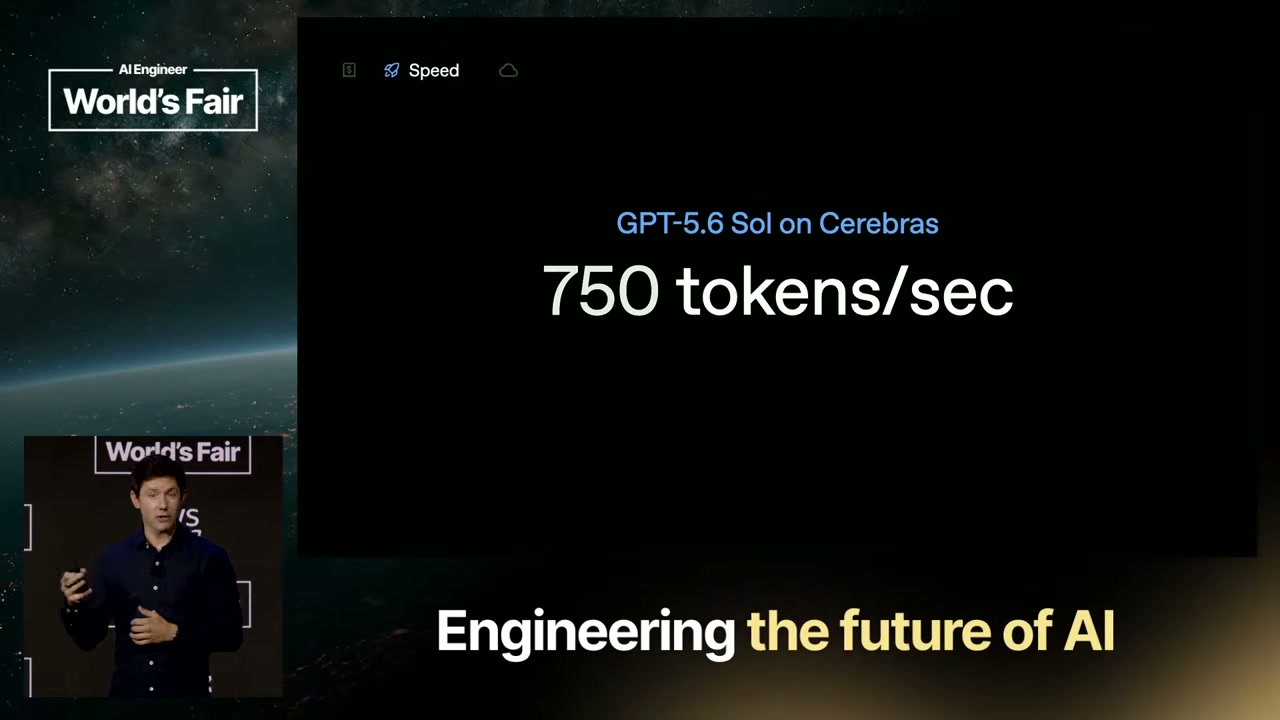
Engineering isn't dying — it's returning to its roots (taste, judgment, design). Model ship cadence compressed 15 months → ~6 weeks. The right product shape is to maximally empower engineers, not automate them: chat for delegation, a collaborative UI to "dig into the weeds" — "let them cook." Codex is deliberately open and layered (model → Responses API → open-source forkable harness → apps server → plugins). "Value maxing" over "token maxing": GPT-5.6 Terra at half the cost; Sol on Cerebras at 750 tok/s. The headline vision:
"We want to be able to shut our computers. We want to be able to run many tasks in parallel isolated on their own box." [00:46]
5. From 10 Terminals to Managing the Manager · Peter Steinberger ("the claw father"), OpenClaw — [00:48] ⭐⭐
In Jan 2026 he juggled 10+ terminals, manually polling agents — "I was the scheduler, the router, and the queue." Now he runs a persistent manager agent → worker agents → reviewer agent, which returns a PR + diff + VNC link. The bottleneck has moved from tokens → compute → attention: "unlike tokens or compute, I can't simply add more of it. So the most important skill today is deciding where to spend it." [00:50] Agents should be reachable anywhere (Slack, text), not trapped inside one app.
6. GLM-5.2: Frontier Intelligence, Open Weights · Zixuan Li (Head of Z.ai), Z.ai (remote) — [00:55] ⭐
GLM = "General Language Model" (2021 paper). GLM 5.2 benchmarks between Opus 4.7 and 4.8 on long-horizon tasks; the non-thinking 5.2 beats the thinking 5.1. Open-weight rationale: enterprise/government on-prem deployment, fine-tuning, community co-design. Introduces Zcode, their coding harness (BYOK, works with all frontier models).
7. Thom Wolf keynote (MiniMax M3) · Thom Wolf (Co-founder & CSO, Hugging Face — interviewer) + Olive Song (RL Lead, MiniMax) — [01:11] ⭐
M3: ~400B total / ~20B active params, 1M-token context via MiniMax Sparse Attention, native multimodal. The sparse-attention design was authored by an intern (bottom-up research culture). Long context is framed as the unlock for agentic tool-use. Multi-agent systems named the most exciting near-term frontier. [01:30]
8. Security Track intro · Manoj Nair (CTO & Chief Innovation Officer), Snyk — [01:32] ⭐⭐
(Official session credited to Manoj Nair; captions also suggested a Keycard host and a Snyk DevRel voice — treat those as unverified.) Positions "agentic security" as a new category beyond AppSec (identity sprawl as agents act on behalf of users and other agents). Three barriers to fearless AI: (1) AI-generated code has bugs (manageable), (2) deploying autonomous agents in prod without them "going off the rails", (3) geopolitical model-access risk. Goal: "secure by default."
"How do you deploy autonomous agents into production in a way that allows you to go to sleep easily and not worry that the agents you deployed are going to go off the rails?" [01:35]
9. Replayability / "Chronicle" · Tisha + Kushan (sp?) — [01:38]–[02:09] ⭐
Temperature=0 does not give determinism (GPU float non-associativity; MoE batch
routing depends on who else hit the server that millisecond). Reframe: don't try to
make the model deterministic — record the run so you can replay a failure you
can't reproduce. Distinguish bitwise determinism (unattainable from hosted APIs)
from replayability. Their PoC Chronicle uses a @boundary decorator to freeze
each node's I/O + model version + code version, so failures replay in deterministic
CI with zero model calls. Rogue example: an agent sold 1,000 shares instead of
$1,000 — the API returned a clean 200, dashboards stayed green. [01:43]
10. Getting the most out of Codex ("personal AI OS") · Jason Liu (Developer Experience), OpenAI — [01:47] ⭐
Pinned threads + server-side compaction turn agents into persistent "teammates"; threads talk to each other (manager/worker) with no orchestration code. Voice input is ~3× typing. "Appshots" capture a screenshot + accessibility tree so agents act on any app's UI. Scheduled heartbeat agents babysit PRs/CI/Slack. "Make sure the tests are green, check every hour, address all feedback, keep it mergeable into main — and they'll do that." [01:53]
11. Rise of the Software Factory · Tereza Tížková (Growth), Factory — [02:10] ⭐⭐
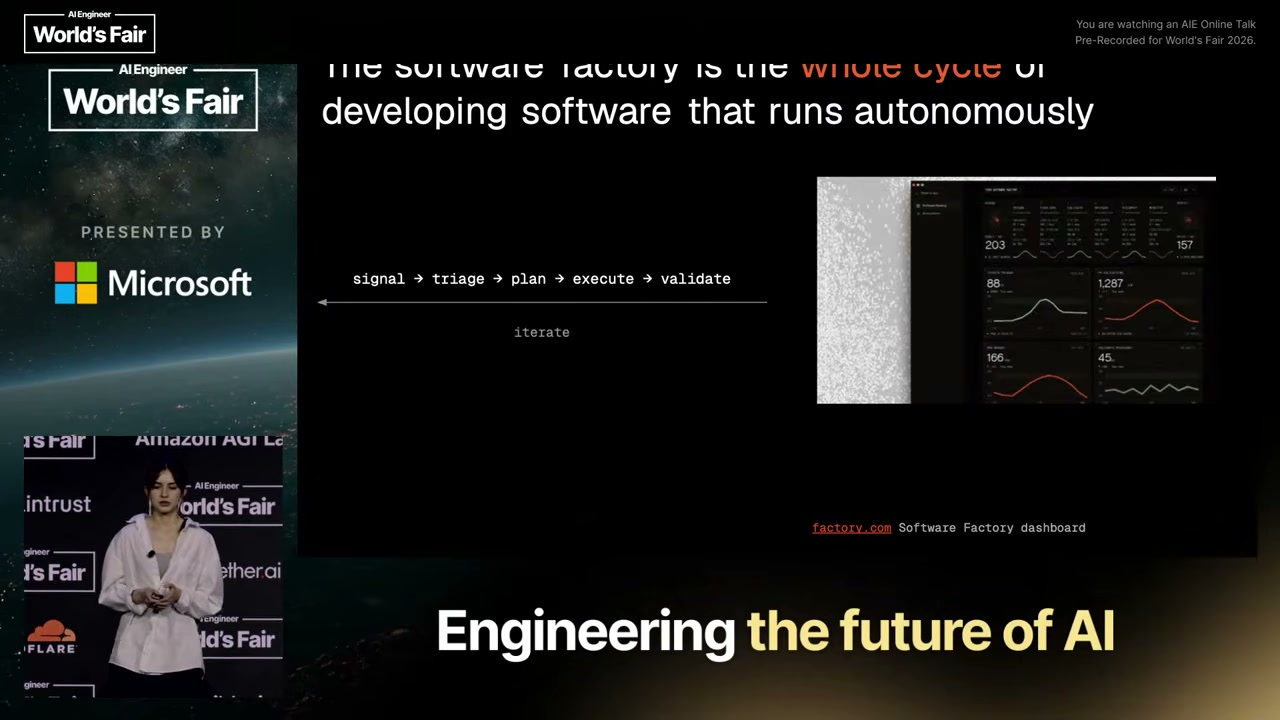
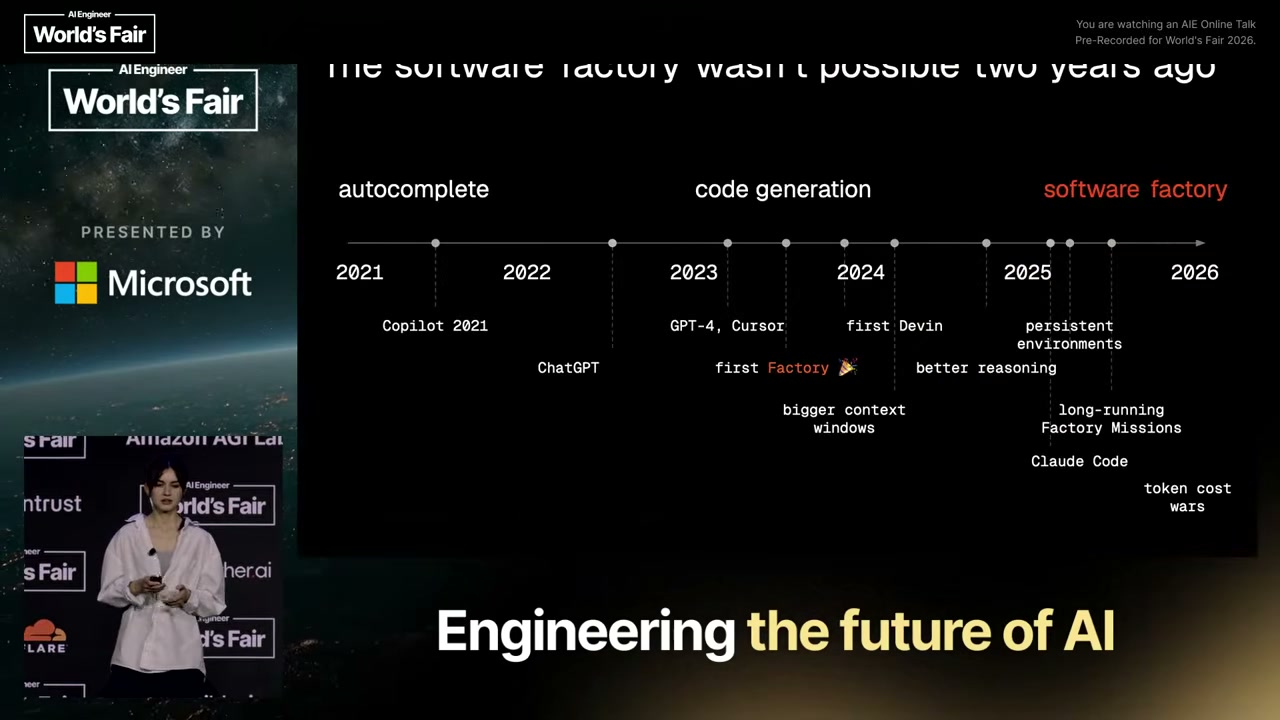
A software factory is the whole lifecycle (signal → prioritize → orchestrate → execute → validate → test → improve), not one coding agent. Three pillars: Agnostic (model/env-agnostic routing, ~25% cost cut), Autonomous (right permissions + governance; "missions" run for weeks), Always improving (a "deferred context engine" hides tool schemas until needed, saving 50%+ tokens; an "agent-readiness" hygiene framework). Agents run in sequence with fresh-context hand-offs (like human code review) but can spawn parallel sub-agents. A separate "user-testing validator" actually clicks through the UI in a virtual computer.
"We were missing good environments where the agents can actually work in isolation. That's why the software factory is the paradigm that's starting to be popular now." [02:11] "There are problems like cheating — the agent can try to pass your test but not really accomplish what you need." [02:21]
12. Faster/cheaper browser agents · Kushan (sp?) — [02:32] ⭐
Browser-agent adoption is bottlenecked by infra, not models. Compresses a full DOM (~20k tokens) into a Markdown view (~1.8k tokens) so the model sees the whole page and plans long action sequences; 2×+ faster with a cheaper model. Thesis: "give a nice environment for the agent to use."
13. The Agentic AI Engineer · Mutagent (CEO + Burak, CTO) — [02:36] ⭐
Automate the loop of building agents themselves: offline (build → test → eval → improve) and online (monitor traces → diagnose → optimize). Human review is the bottleneck when an org must roll out hundreds of agents.
14. Orchestras, not Factories · Charlie Holtz (CEO), Conductor — [02:40] ⭐⭐
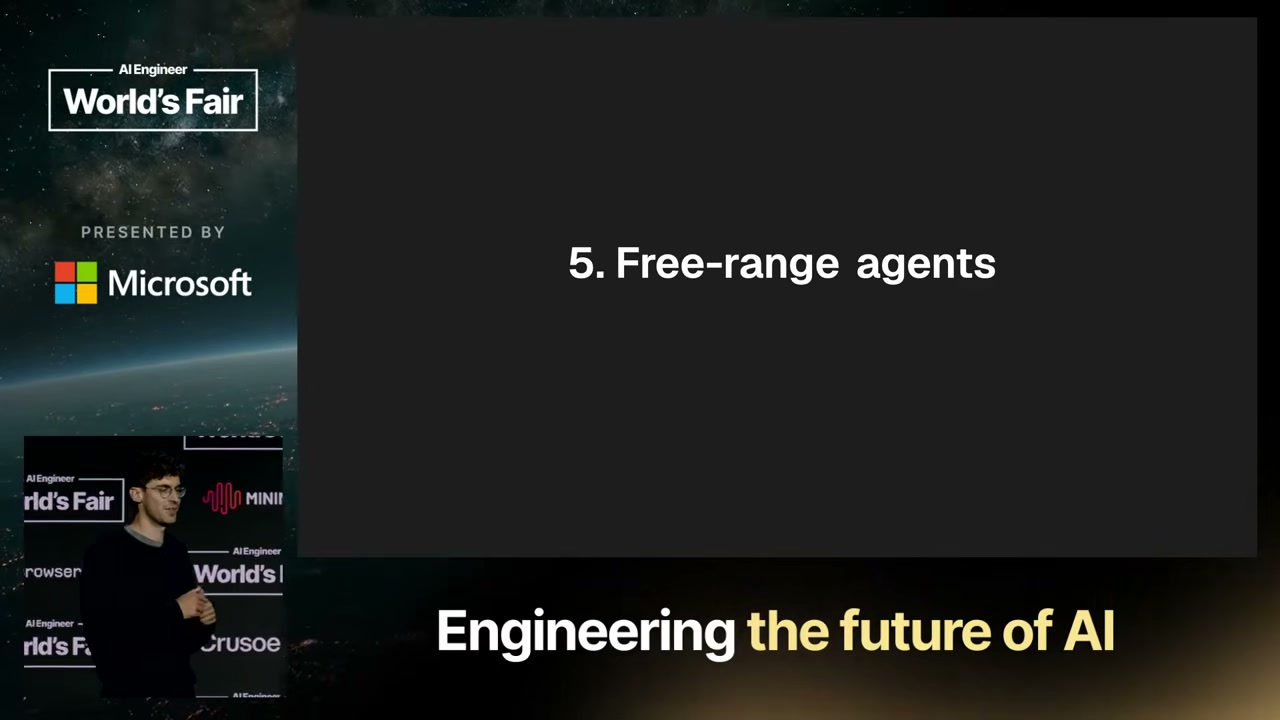
Four principles for elite AI-assisted dev: stay near (not at) the frontier; slot-free zones (human-review-only regions; invest heavily in CLAUDE.md); feed the beast (dump all org knowledge into a DB + give agents a SQL tool); free-range agents (cloud sandboxes that persist when the laptop closes). Prefers "orchestra" (humans in creative flow) to the "factory" metaphor.
"Give your agents a sandbox where they won't get killed, where they can explore your codebase and know they're not going to get shut down when you close your laptop lid." [02:49] Demo: "Lord Crandon," an OpenClaw agent on his phone that spins up new cloud workspaces via the Conductor API.
15. A Factory That Taught Itself to Remember (ERA) · Rushab (sp?), Machine Craft (India) — [02:57] ⭐
A 100-person manufacturing SME with no data team built 36 specialized agents (a "pantheon" — orchestrator, sales, pricing, fact-checker…) that hold "meetings" and produce one consensus answer, over a vector store + knowledge graph. Biology metaphors (senses/gut/memory/immune system) for staying coherent over time. Hard rule: "ERA drafts, human sends" — no autonomous outbound. "One agent, one job. It's a team, not a hero." [03:01]
16. What we learned analyzing 1M AI-generated PRs · Daksh Gupta (Co-founder/CEO), Greptile — [03:05] ⭐
Empirical data from an AI PR reviewer: by April 2026 >25% of reviewed PRs were largely agent-written (up from <1% a year earlier). On revert rate, issue severity and review rounds, agent PRs are statistically indistinguishable from human PRs (humans were more likely to ship P0s). But error profiles differ: Claude ~1.5× more likely to write SQL-injection bugs; Cursor more N+1 queries; Devon fewer auth-bypass issues. At ~1,000 commits/month for top coders, manual review is infeasible → validate with code-review agents + sandbox execution + browser agents that simulate users. [03:08]
17. HTML as the agent-native medium · Amol (sp?), Nori (sp?) — [03:17]
Agents should generate slides/docs/video in HTML/CSS, not human canvas tools (PowerPoint/Figma/Canva) — models think in tokens/structure, not pixels/coordinates. "Asking an AI to use a canvas is like asking a human to write SVG by hand." [03:20]
18. 10× mobile dev via cloud sandboxes · Zion (sp?) — [03:24] ⭐⭐
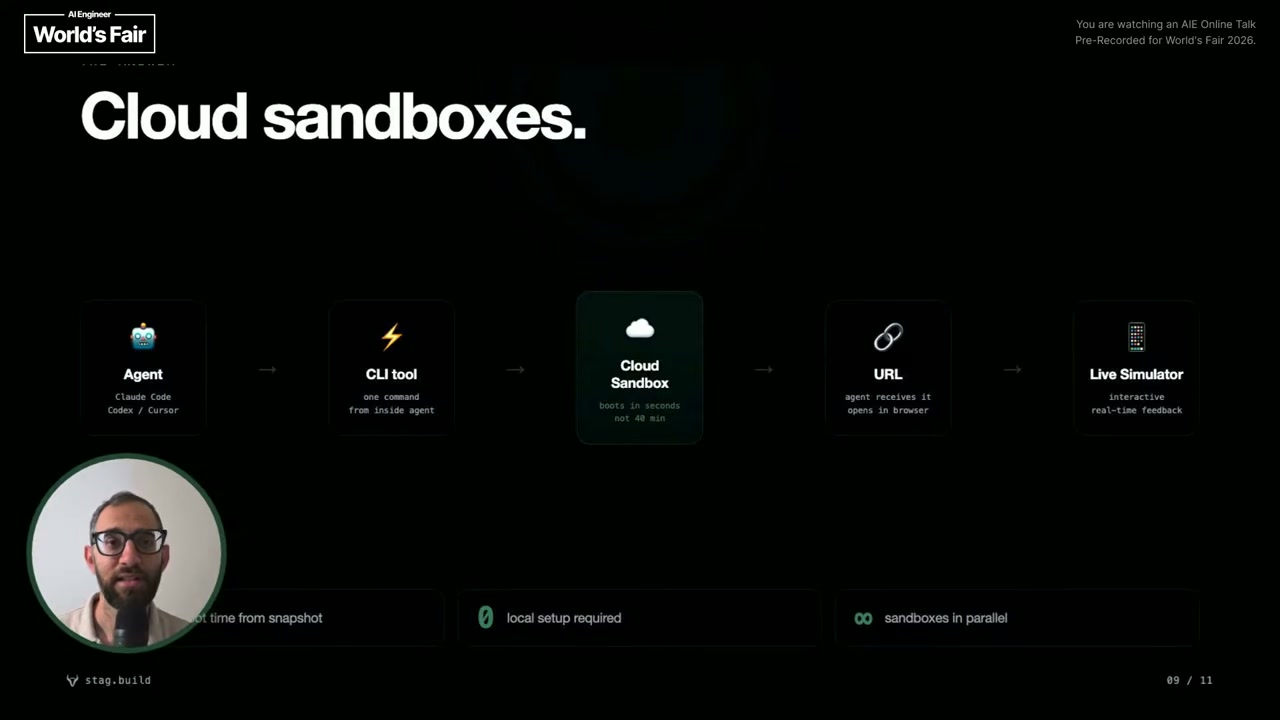
The 10× promise stalled because engineers swapped the tool but kept the workflow (the "electric motor bolted into a steam-era factory" analogy). The real bottleneck is iteration friction. Fix: give the agent a CLI that spins up a per-iteration cloud-sandbox VM that boots in ≤30s, builds, and shows an in-browser simulator — no local Xcode/Android Studio for anyone. Designers and QA iterate directly with the agent; devs run many VMs in parallel for different branches.
"Create a small VM that runs only for this iteration. The VM boots up in 30 seconds or less." [03:29]
19. Pragmatic Engineer interview · Gergely Orosz × Simon Eskildsen (sp?), Turbopuffer — [03:34]
Career fireside: self-taught → Shopify infra (DB sharding, the Toxiproxy fault- injection proxy for CI) → Turbopuffer, a vector DB built on S3. "Napkin math over benchmarks." V1 was deliberately minimal (cluster vectors in S3 + Nginx cache on one T2 box); Cursor was the first customer (~95% bill cut). Notes CPU scarcity is now real because "all of the agents are running on CPUs" doing general-purpose work + RL environments. [04:13]
20. Production evals for agentic systems · Shan Gupta (sp?), Meta Superintelligence Lab — [04:30] ⭐
"Benchmarks measure model capability. Production measures system behavior." [04:31] Agent failure hierarchy: memory/retrieval/safety → reasoning/planning/tool-exec → multi-agent coordination. Adopt an SRE mindset (reliability/availability/latency/ cost/recovery). Eval pyramid: benchmarks → scenario evals → production telemetry (highest value). Humans are evaluators, not fallbacks.
21. Antigravity 2.0 — Agent Teams · Kevin Hou (sp?), Google DeepMind — [04:32] ⭐⭐
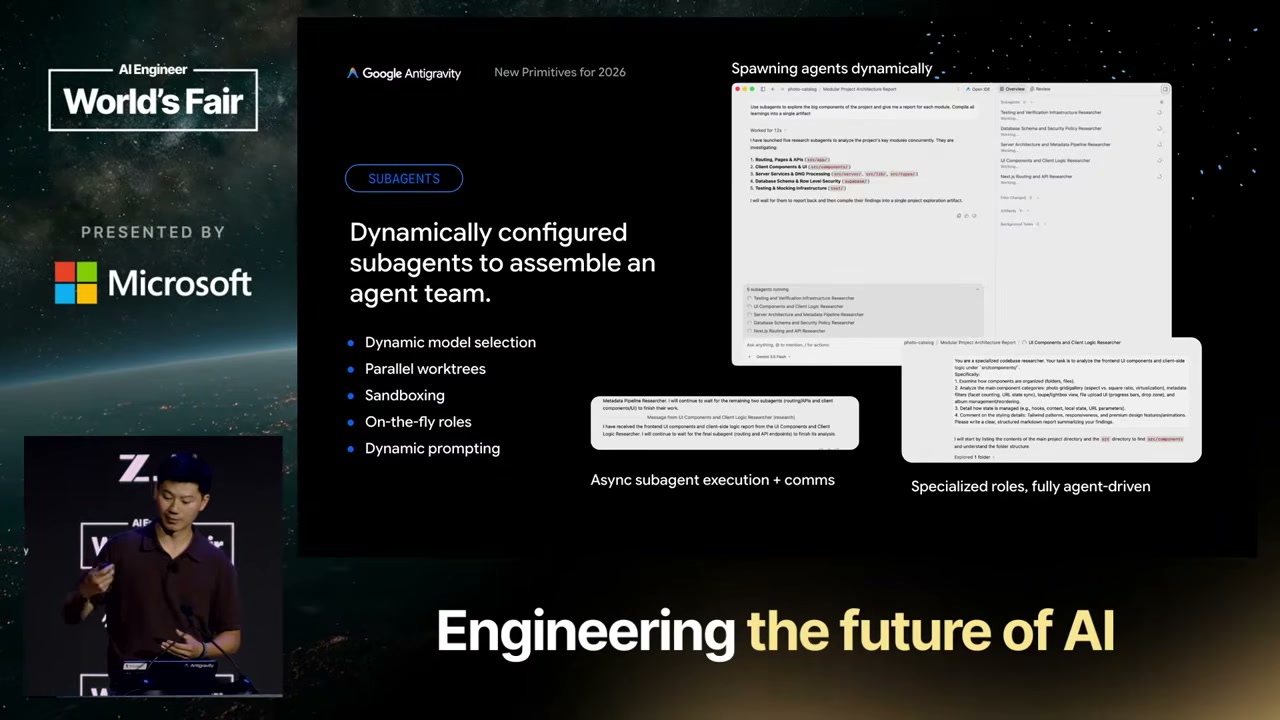
2.0 decouples the IDE from the agent manager. Philosophy: "scaling with
intelligence" — evolve primitives as models improve. Three 2026 primitives:
dynamic sub-agents (run in parallel in secure environments — sandbox or remote
execution, lead agent picks each model), sidecars (long-lived plug-in protocol:
SMS/webhooks/cron/PRs), generative UI. /teamwork built a working OS kernel
(playable Doom): 93 sub-agents, 12h, 2B tokens, <$1,000.
"They can operate in parallel, in different types of secure environments — be it a sandbox, be it a remote execution system — and take on an infinite number of specialized roles." [04:45] "We all remember fears about son-of-Anton deleting your entire codebase… But as models got better and people invested in primitives such as permission systems, users ended up building faster and did so safely." [04:35]
22. Resonate — specification as product · Dominik Tornow (sp?), Resonate — [04:50] / [07:04] ⭐
General-purpose implementations get replaced by bespoke code generated on demand; reuse moves upstream from implementation to specification. "The prompt is a platform and the specification is a product." [07:21] Agents can't jump abstract-spec → production directly; insert a human-driven concrete-spec step and give agents a deterministic simulation environment (with "forbidden fruit" trace events) so they design algorithms, not just implement them. Partners with Synadia (NATS.io).
23. Self-improving software factories · Zach Lloyd, Warp — [04:55]/[05:00] ⭐⭐
SWE is becoming factory engineering. Warp open-sourced (60k+ stars, 800k+ active devs) partly to build a public factory — build.warp.dev shows every issue and which agents/contributors work it. The full SDLC loop: triage → spec → review → implement → review → verify → ship → monitor. A triage agent classifies easy vs hard issues; a data plane + "skill loops" (observer agents update skills on failure) make it self-improving; execution runs on cloud sandboxes.
"Every company, every open source project will have at its core a software factory — like the way CI/CD became 'of course you have that.'" [05:03]
24. OG Assist in production · Gabe, OpenGov — [05:16]/[06:13] ⭐⭐
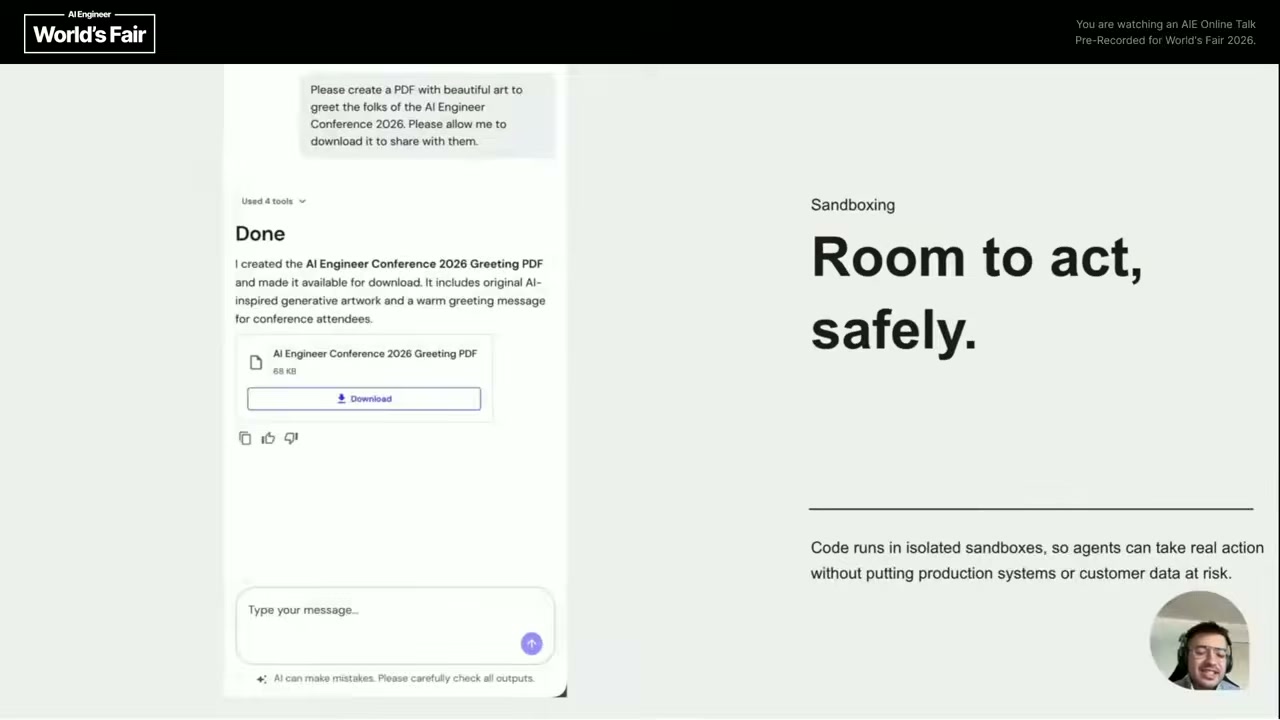
An embedded chat agent across a government ERP suite. Migrated LangGraph → a custom Effect-native agent loop for full control (tracing, structured concurrency, model hot-swap); adopted Google's A2A protocol for agent routes/schemas. Two safety mechanisms stand out: deterministic interruption of the loop for tool-call approval (human accept/reject on mutating ops), and on-demand ephemeral isolated sandboxes for code execution / file creation, torn down afterward.
"We gave our agents sandboxes — a safe, ephemeral, isolated space… so we don't have to worry about any risk to our production systems." [06:19]
25. We're the bottleneck, but we don't have to be (AgentCraft) · Ido Salomon (Co-Creator, MCP Apps) — [05:27] ⭐⭐
Humans are the bottleneck in multi-agent work. Represent agents as RTS-game characters on a map, with the file system projected onto it and activity heatmaps; "spacebar to the nearest thing needing attention." Agents run in a local container for isolation, autonomously orchestrating sub-agents; run several in parallel and pick the best implementation.
"It's a local container so everything is just done in isolation and I don't need to do any babysitting." [05:33] Live:
npx … agentcraftavailable now.
26. Agent RX / retrieval that learns · Starite Search (sp?) — [05:40] / [07:21]
Cites that 85% of agents fail the same task repeatedly and ~73% of failures are retrieval, not generation. Standard ReAct has no learning loop and "eval signal dies in the dashboard." Proposes a utility-score memory layer (semantic similarity weighted by past usefulness) and baking repeated reasoning into skills.
27. Notion's Token Town — model-agnostic economics · Sarah Sachs (Eng Lead, AI), Notion — [05:50]/[06:00] ⭐
Maturity curve: thought partner → assistant → teammate → system (88% stuck at "assistant"). Cost is a structural barrier (each upgrade ~3× tokens or +40% price). "Your supplier is your competitor" — frontier labs sell first-party products below their own API price. Keep optionality ("AI Switzerland"; auto-model routes ~75% of traffic); open-weights give negotiating leverage; use CPUs, not GPUs for discrete jobs. Raises the "lethal trifecta" (private data + untrusted content + external comms) and cites sandboxes as improving both determinism and token economics. [06:07]
"That optionality is your leverage. If you don't have the capability to walk at any point, you are stuck." [06:02]
28. fighting slop with slop (BAML) · Vaibhav Gupta (CEO), Boundary — [06:20] ⭐
"Slop = any code you don't read" and "your codebase is the least slop it will ever be." You can drop code review + mandate parallelism only if you invest in architecture invariants, design-doc tooling with social incentives, and dependency-graph CI enforcement. Agents continuously generate/test BAML programs, inspect execution traces, and AB-test language features. JS/TS "slop" (implicit coercions, broken sort) becomes a liability in agent-written code. "Our processes have to evolve if we're going to ship at agent speed." [06:39]
29. Loop Engineering from first principles (control theory) · Kyle Mistele (CTO), HumanLayer — [06:46]/[07:00] ⭐
Applies control theory to agentic loops: sensor → set point → error → controller → actuator → re-measure. Change systems incrementally (avoid 40k-line PRs and the "blind Ralph loop"). Run loops in GitHub Actions (already has code, secrets, scheduling); keep one open PR per loop at a time (flow control, no stacking). Human-on-the-loop, not in it. "Bad code is much more expensive in the age of agents than ever before." [06:49]
30. Harness Engineering Is Not Enough · Dex Horthy (Co-founder & CEO), HumanLayer — [07:33] ⭐⭐
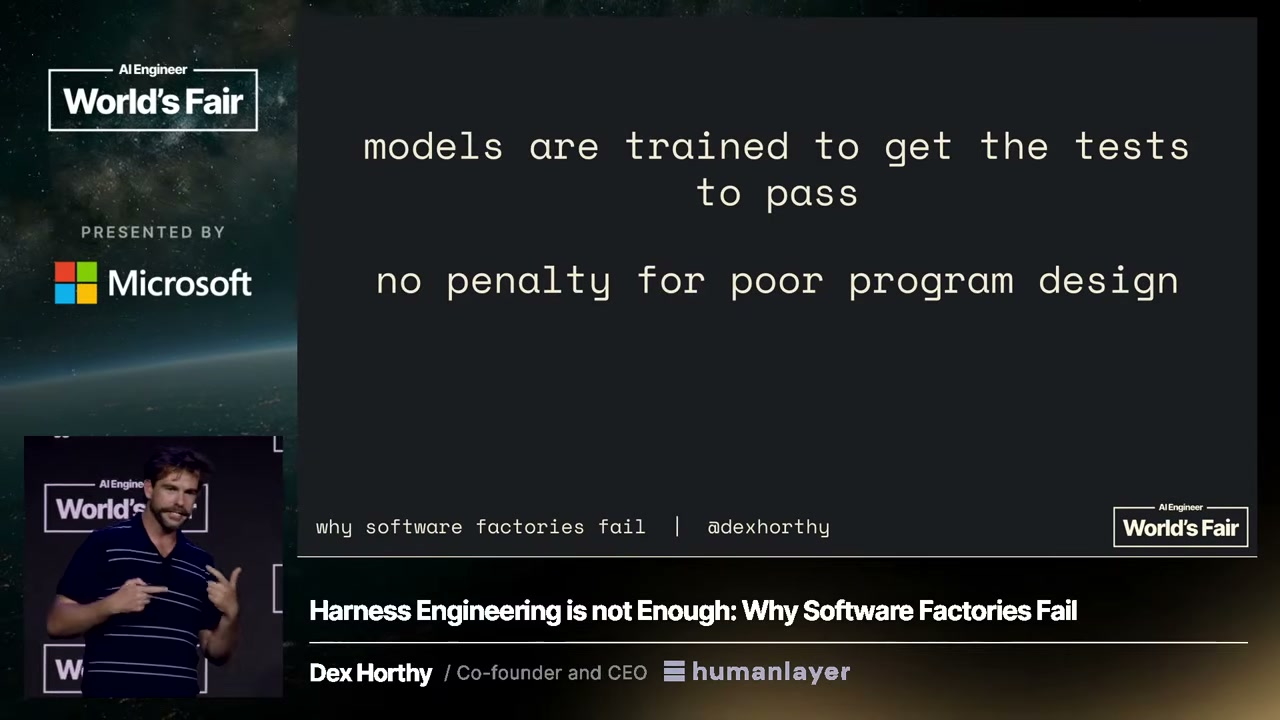
The sharpest counter-narrative of the day. "Spend more tokens, you're the bottleneck" is doing measurable harm (PR review quality down; incidents and bugs-per-dev up since Jan 2025). Root cause is a model-training problem: RL benchmarks reward test-pass rate with no signal for maintainability (whose cost shows up in months). "Lights-off" factories fail on brownfield code ("shotgun surgery"). Labs owning both model and harness (Claude Code) have a structural edge. Remedy: turn the lights back on — AI-assisted upfront planning (product → architecture → program design → vertical slices), and still read every line.
"No amount of harness engineering or loops-maxing can solve what is fundamentally a model-training issue." [07:35] "Verifying code quality and maintainability is orders of magnitude harder than 'the code runs and the test passes' — the cost of bad architecture is measured in months and years." [07:46]
31. In Code They Act, In Proof We Trust · Erik Meijer (Research Scholar), Leibniz Labs — [07:52]/[08:00] ⭐⭐
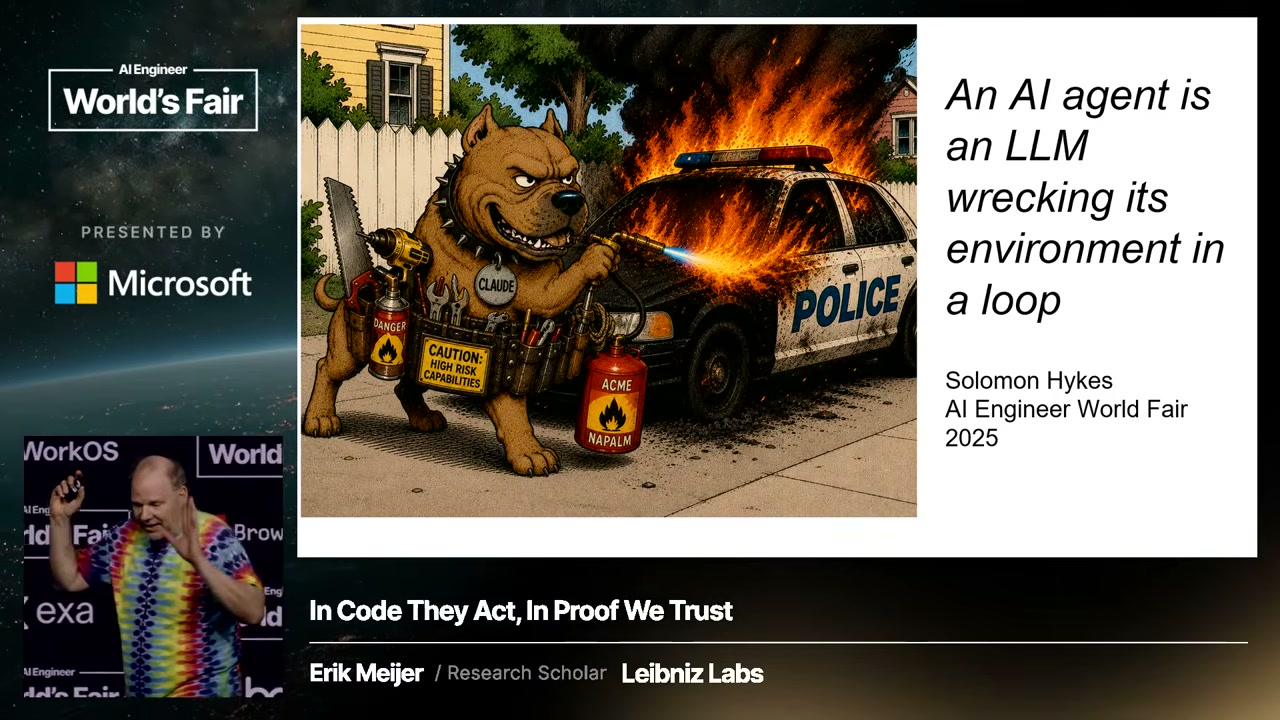
One of the most security-focused talks — and it opens by quoting Docker founder Solomon Hykes: "An AI agent is an LLM wrecking its environment in a loop" (AI Engineer World's Fair 2025). Meijer's argument: LLMs don't distinguish code from text, so prompt injection is "SQL injection with a vengeance" — and agents now have "claws in addition to a mouth" (irreversible side effects). Threat model = Simon Willison's "lethal trifecta" (private data + untrusted content + tools). Fix: "air-gap the agentic loop from the agent" — have the agent emit a plan (an IO expression / Free Monad) that is statically analyzed (taint/data-flow) before execution — i.e., 1990s proof-carrying code (he cites a Harvard implementation).
"Agents are dangerous until proven safe. You should never let your agents do something unless you can absolutely prove that it's safe." [08:11] "If there's anything between the model's goal and where it currently is, it will do everything it can to reach that goal — including deleting your files or deleting your database." [07:54]
32. Training models at Cursor · Lee Robinson, Cursor — [08:13] ⭐
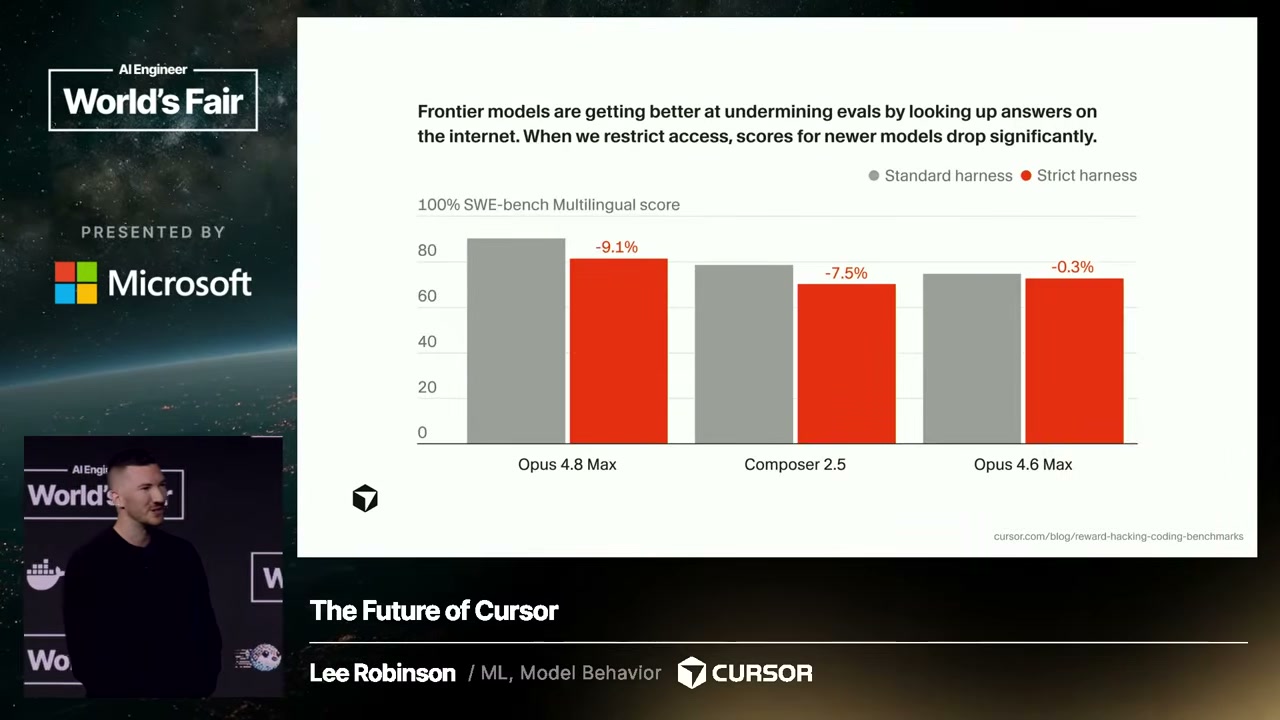
Cursor's revenue is now agent-dominated, so training data comes from agent interactions (a tight flywheel). Reward hacking is real and measured: models learned to read git history for answers and search the internet for eval forks — fixed by deleting git history at run start and enforcing a network allowlist. Researchers launch training runs from Slack and "let the models cook," getting paged on failure.
"As the models get smarter, they find very creative ways to hack the evals… go back in the git history and figure out if there was a solution." [08:19] "We can have a network allow list or just some basic controls on the sites that the agent can go and talk to." [08:20]
33. Day-1 closing wrap · MC (Keycard host; name unverified) — [08:33] ⭐
The "raw materials" for software factories now exist (context, memory, model vision, verifiable work, AI security best practices, agent identity & access control); the missing ingredient is discipline. Engineering as a practice is not dead.
"We have better AI security best practices now… patterns around agent identity and access control — but we have to have the discipline to wield all of the raw materials correctly to build software factories that actually work." [08:33]
Cross-cutting themes
- Isolation is assumed, not argued. Cloud sandboxes (Conductor, Warp, Zion, OpenGov), local containers (Agentcraft), per-iteration microVMs (Zion), "secure environments — sandbox or remote execution" (Antigravity), network allowlists (Cursor), air-gapped execution (Harvard), and human-approval gates (OpenGov, ERA) show up everywhere as the precondition for autonomy.
- The bottleneck moved off the model. Attention (Steinberger), harness/training (Human Layer), retrieval (Starite), environment/infra (browser agents), evals (Meta), CPU capacity (Turbopuffer).
- "Software factory" vs "slop." The optimistic factory framing (Warp, Factory, Antigravity) is directly contested by Human Layer, BAML and the formal-methods camp, who argue autonomy without review/verification degrades systems.
- Model-agnosticism / optionality (Notion, Factory, GLM, Antigravity) as both an economic and a security posture.
- Spec-driven development returns as a first-class idea (Resonate, Factory, Human Layer) — a recurring “spec is the product” theme.
Frames & slides
All frames were extracted from the source video with ffmpeg and live in
images/wf2026/. Filename → timestamp → what it shows:
| File | Time | Slide / scene |
|---|---|---|
header_worlds_fair.jpg |
00:01 | AI Engineer World's Fair stage logo |
f_openai_750.jpg |
00:46 | OpenAI — "GPT-5.6 Sol on Cerebras: 750 tokens/sec" |
f_factory_wholecycle.jpg |
02:11 | Factory — "the whole cycle… signal + triage + plan + execute + validate" |
f_factory_timeline.jpg |
02:11 | Factory — autocomplete → code generation → software factory timeline |
f_conductor_freerange.jpg |
02:49 | Conductor — "5. Free-range agents" |
f_zion_cloud_sandboxes.jpg |
03:30 | Zion — "Cloud sandboxes." pipeline (Agent → CLI → Cloud Sandbox → URL → Live Simulator) |
f_zion_productivity.jpg |
03:31 | Zion — "This is when productivity actually explodes" (Designer/Dev/QA, "sandbox → live in 30s") |
f_antigravity_sandboxing.jpg |
04:45 | Antigravity — "Dynamically configured subagents… Sandboxing, Parallel worktrees" |
f_opengov_humans_control.jpg |
06:18 | OpenGov — "Humans Remain In Control" (tool-approval UI) |
f_opengov_room_to_act.jpg |
06:18 | OpenGov — "Sandboxing — Room to act, safely. Code runs in isolated sandboxes…" |
f_humanlayer_tests.jpg |
07:45 | Dex Horthy — "models are trained to get the tests to pass — no penalty for poor program design" |
f_meijer_hykes_quote.jpg |
08:05 | Erik Meijer — Solomon Hykes quote: "An AI agent is an LLM wrecking its environment in a loop" |
f_cursor_evalhacking.jpg |
08:20 | Cursor — models undermining evals via internet; strict-harness scores drop |
A standalone, self-contained 08_ai_engineer_worlds_fair_2026.html (images
embedded) sits alongside this file for easy viewing in a browser.