AI Engineer Singapore 2026 — Day 2
Video: https://youtu.be/m12vGjfbNlo Channel: AI Engineer · Uploaded: 2026-05-17 · Length: 9h 28m · Venue: Capitol Theatre, Singapore Title: AIE Singapore Day 2 ft. Google DeepMind, OpenClaw, Adaption, Arize, Cloudflare, Robot Company & more
Illustrated, timestamped notes on the AI Engineer Singapore Day-2 mainstage. Split by talk using the video's own chapter markers; break/meditation filler is omitted. Clickable timestamps jump into the video. Auto-captions mangle some names — corrected against the on-screen title cards where visible (which is how we caught OpenClaw's second presenter, Onur Solmaz).
TL;DR
Day 2 is the harness-engineering day, bracketed by a large embodied-AI / robotics block and a design block. If Day 1 asked “what can agents do?”, Day 2 asks “what do you wrap around the model so it's reliable and safe?”
Three throughlines:
- The harness is the product. IBM does a literal “Harnesses in AI: A Deep Dive”; Smithery argues “the harness decides the interface”; OpenClaw ships a plugin engine; Mastra, Southbridge, Interfaze and Vibe Kanban all sell the scaffold (loop control, budgets, planning/review) rather than a model.
- Determinism and structural guardrails around a non-deterministic core. JJ Geewax (DeepMind) builds deterministic boundaries and warns “your own documents are prompt-injecting your agent”; Tusk's Fence puts guardrails at the OS layer (“stop asking your agent to behave” — agent overreach needs a structural fix, like prepared statements or TLS); Cloudflare runs one-shot agent code in a V8 isolate (“from tool calls to tiny computers”); IBM enforces limits in the harness, not the prompt.
- Embodied AI is arriving fast — and starts caring about safety. The Robot Company, Tesseract (BCI), Bifrost (sim), OpenGraph (touch data) and Cortex AI map the robotics data stack; Cortex adds a real physical-safety section (staged sim→single-joint→full execution before running agent-written code on hardware). A parallel design thread (Microsoft's “magic pencil,” Magic Patterns, MagicPath, Lica) argues taste and judgment are the human edge as generation gets cheap.
Talk index
Timestamps link into the video. Speaker names and talk titles are taken from the conference's own on-screen title cards and running order. Rel flags agent-safety / sandboxing / isolation content: ⭐⭐ = substantial · ⭐ = touches it · · = tangential.
| # | Time | Talk | Speaker · Org | Rel |
|---|---|---|---|---|
| 1 | 00:08 | Planning States and Context Abstractions in Alyx | SallyAnn DeLucia, Arize AI | · |
| 2 | 00:24 | Scenario-Specific Evals with ODDs and Synthetic Data | Timothy Lin, Resaro | · |
| 3 | 00:35 | From Tool Calls to Tiny Computers | Abhishek Kankani, Cloudflare | ⭐⭐ |
| 4 | 00:48 | Harnesses in AI: A Deep Dive | Tejas Kumar, IBM | ⭐⭐ |
| 5 | 01:32 | From Models to Production at DeepMind Scale | JJ Geewax, Google DeepMind | ⭐⭐ |
| 6 | 01:53 | Everything Is a Factory | Geoff Huntley, Independent | · |
| 7 | 02:11 | State of OpenClaw | Onur Solmaz & Vincent Koc, OpenClaw | · |
| 8 | 02:22 | AI Characters with Personality, Memory, and Human Inner Life | Vishnu (Vish) Hari, Ego AI | · |
| 9 | 02:31 | Own Your Cloud: Personal Infrastructure Against Digital Feudalism | Ben Guo, Zo Computer | · |
| 10 | 02:42 | Embedding Pi: The Minimal Coding-Agent Loop | Matthias Lubken, Tavon AI | ⭐ |
| 11 | 02:56 | Design as the Competitive Edge in the Age of AI | Josh Newton, Microsoft AI | · |
| 12 | 03:07 | Patterns for Production AI Agents in TypeScript | Sam Bhagwat, Mastra | · |
| 13 | 03:25 | Parsing Billions of Docs: Production Failure Modes | Pierre-Loic Doulcet, LlamaIndex | · |
| 14 | 03:38 | Stop Asking Your Agent To Behave | Jun Yu Tan, Tusk | ⭐⭐ |
| 15 | 05:01 | Beyond Brute Force: The Era of Adaptive Intelligence | Sara Hooker, Adaption Labs | · |
| 16 | 05:17 | Agents That Schedule Their Own Compute | Vincent Wu, MiniMax | · |
| 17 | 05:29 | Teleoperated Robots as the Data Engine for Autonomy | Daniel & Siddharth Krishnan, The Robot Company | · |
| 18 | 05:41 | BCI Painting and Embodied Creative Agency | Justin Baird, Tesseract with Kai Ming | · |
| 19 | 05:55 | Sim-Generated Worlds for Robotics Evals | Aravind Kandiah, Bifrost | · |
| 20 | 06:10 | Sensorizing Humans for Humanoid Training Data | Julia Kim, OpenGraph Labs | · |
| 21 | 06:19 | Full-Stack Robotics Data Operations | Suveen Ellawela, Cortex AI | ⭐ |
| 22 | 06:57 | Design Craft That AI Cannot Automate | Jay Demetillo | · |
| 23 | 07:09 | AI-Native Design Systems for Brand-Faithful UI | Alex Lee, Magic Patterns | · |
| 24 | 07:20 | No-Gatekeeping Design for Engineers | Sabina Cabrera, MagicPath | · |
| 25 | 07:34 | Layered Editability and Design Intelligence | Priyaa Kalyanaraman, Lica World | · |
| 26 | 07:44 | The Company Brain: Agents Need a Source of Truth | Conor Brennan-Burke, Hyperspell | · |
| 27 | 07:56 | Plan, Preview, Orchestrate: Cloud Coding Agent Primitives | Heng Hong Lee, Lightsprint | · |
| 28 | 08:07 | All We're Going To Do Is Plan and Review | Louis Knight-Webb, Vibe Kanban | · |
| 29 | 08:19 | Deterministic Multimodal Tasks with Encoder–Decoder Architecture | Harsha Khurdula, Interfaze AI | · |
| 30 | 08:31 | High-Context Agent Runtimes for Legacy Systems | Hrishi Olickel, Southbridge | ⭐⭐ |
| 31 | 08:44 | Give Agents Agency | Henry Mao, Smithery | ⭐⭐ |
| 32 | 08:56 | Self-Evolving Agent Harnesses and Code Intelligence Tools | Rach Pradhan, Independent | · |
The talks
Planning States and Context Abstractions in Alyx · SallyAnn DeLucia, Arize AI — 00:08:36 ·
Arize AI's head of product walked through four hard-won lessons from three years building Alyx (their AI engineering agent), now at version 2.0 with planning and reasoning. The core architectural move is a to-do system with four explicit states — pending, in-progress, blocked, and completed — injected after system instructions on every LLM call so plans are never truncated from context: "we never want the plan to get truncated… so we actually inject this every time we're making an LLM call right after the system instructions" [00:13:28]. To tame large observability payloads, Alyx uses a "large JSON" abstraction that stores bulk tool output in serialized memory and hands the agent only a compressed-structure ID, compressing values but preserving all field names and array shapes so Alyx can still reason about what data exists. A finish gate enforces task completion — calling the finish tool with incomplete to-dos returns a hard structured error, not a soft prompt nudge — and a blocked state handles human-in-the-loop pauses without stalling the agent.
Scenario-Specific Evals with ODDs and Synthetic Data · Timothy Lin, Resaro — 00:24:54 ·
Timothy Lin of Resaro (caption renders "Rsaro"/"Rizaro" — corrected to Resaro from context) argued that both benchmark-gaming and ad-hoc "vibe testing" fail mission-critical AI deployments in healthcare, defence, and security, and proposed Operational Design Domains (ODDs) as the structured middle ground: explicitly scoping the constraint space of valid test cases, expected behaviors, and deliberate out-of-scope exclusions. From ODDs, Resaro builds automated pipelines that translate domain requirements into test cases, run data-quality filters, and use synthetic data generation to fill coverage gaps — especially for rare edge cases that real-world datasets cannot supply. He showed a concrete example of VRM evaluation under weather augmentation (rain, snow, fog), where smaller deterministic models — depth-map comparators, subject-detection classifiers — catch generation artifacts like phantom humans or mis-rendered tanks far more scalably than human eyeballing. The underlying insight is reframing eval as a data-generation problem: "the data is the bottleneck… we can shift the problem from eval to how do we generate the right test cases that gives us the confidence for deployment" [00:29:55].
From Tool Calls to Tiny Computers · Abhishek Kankani, Cloudflare — 00:35:50 ⭐⭐
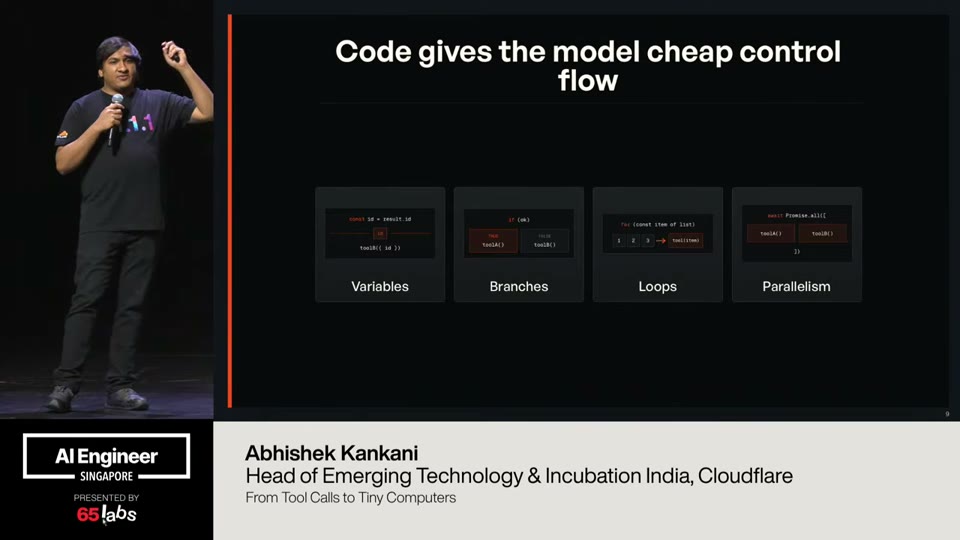
Abhishek Kankani, who leads the emerging tech and incubation team at Cloudflare India, presented Code Mode — a library that converts MCP tool definitions into TypeScript type declarations and asks the model to emit a single executable code snippet instead of issuing sequential tool calls. The payoff is dramatic: a five-to-eight turn monitoring workflow (list logs → fetch metrics → conditional check → decide rollback) collapses to one LLM turn, eliminating redundant context accumulation and round-trip latency. Applied to Cloudflare's own 2,500-API surface — which would overflow most model context windows at 1.7 million tokens as standard MCP tools — a search-then-execute code-mode pattern reduces the required context to roughly 1,000 tokens, a 99.9% reduction. The critical security question of where model-generated code runs is answered with Cloudflare Workers' V8 isolates: zero cold-start, per-request isolation, no secret leakage to the host, and caller-controlled capability scoping — "workers give us a great boundary… does not have chances of leaking secrets, you know, getting malicious code into your actual main setup" [00:47:24].
Harnesses in AI: A Deep Dive · Tejas Kumar, IBM — 00:48:50 ⭐⭐
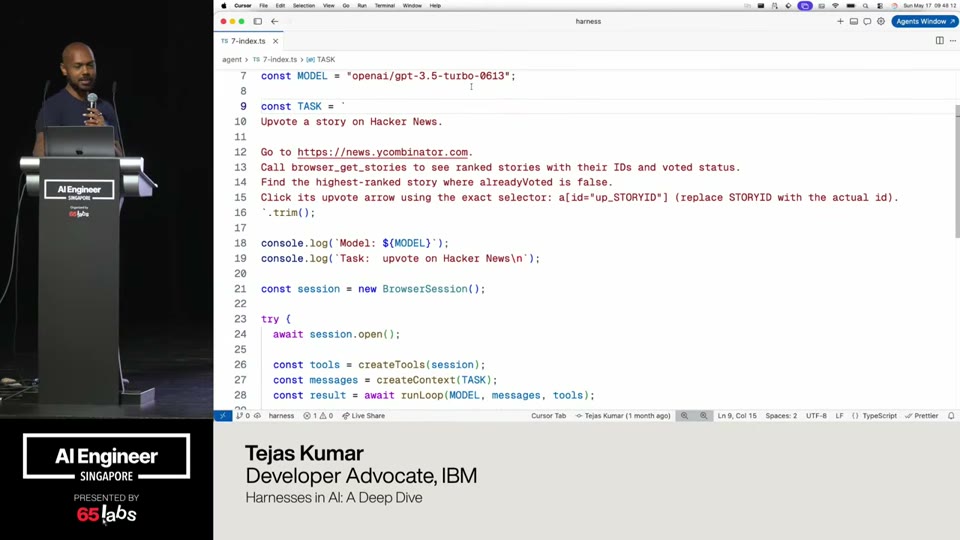
Tejas Kumar (caption renders "Tis" — full name confirmed from talk context as Tejas Kumar), AI engineer at IBM, gave a first-principles live-coding demo of agent harness construction, defining a harness as "everything around your agent — the tool chain, the environment in which your agent executes — that gives it the best chance of success and reliability" [00:52:55]. Starting from a broken Playwright browser-use agent (GPT-3.5 Turbo, upvoting HackerNews articles) that silently lied about success after hitting a login wall, he added three harness layers without changing the prompt or model: iteration and message-count guardrails in guardrails.ts, a verify step that inspects the agent's own tool-call history to detect whether an upvote click or a login redirect actually occurred, and a loginHandler that owns the browser session at the harness level and injects authenticated state back into the message chain. The demo succeeded on the hardened harness with the same cheap, unchanged model — "we did not prompt it harder and we're still using an old model… but the harness is now giving us some truth" [01:03:28] — and he closed by noting IBM's open-source OpenRAG harness as a reference enterprise implementation.
From Models to Production at DeepMind Scale · JJ Geewax, Google DeepMind — 01:32:42 ⭐⭐
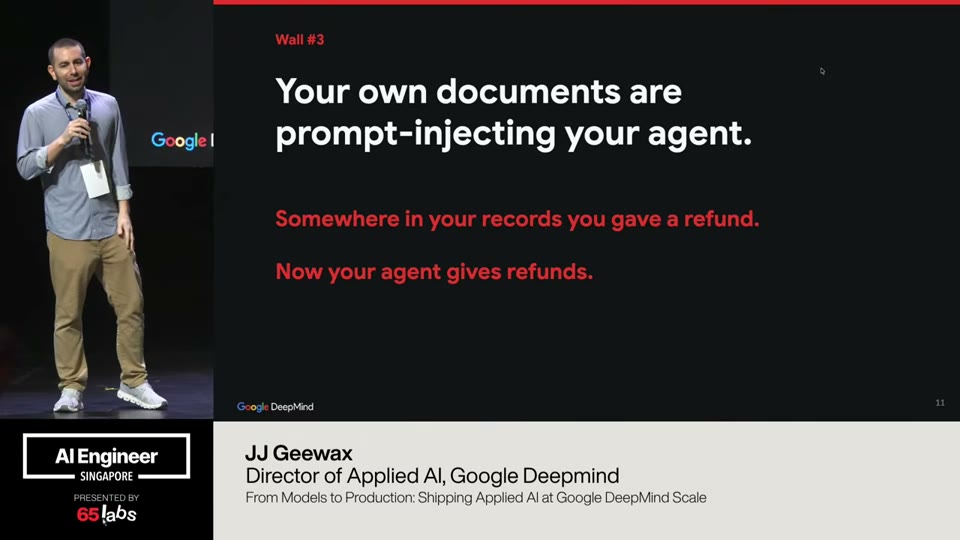
JJ Geewax, engineering director leading the Applied AI team at Google DeepMind in Singapore, argues that the core production challenge is wrapping non-deterministic LLMs in deterministic scaffolding. He identifies three recurring failure modes — prompt injection, the illusion of temperature-zero determinism ("it's not the same thing as setting a random seed in a pseudo-random number generator" [01:41:15]), and poisoned RAG pipelines (e.g. a test record that sells a car for $1 leaking into production answers) — and proposes an architecture where LLMs act only as classifiers/routers and structured JSON-to-JSON transformers, with small fine-tuned ML classifiers performing final safety checks context-free to close off prompt injection entirely. He also describes a multimodal live-camera pipeline at DeepMind that pairs a fast on-device model (50 fps, <50 ms latency) with Gemini for semantic understanding, since "the models just aren't there yet" to do both at once. The central takeaway: "we can't just tell our customers, don't worry, I added 'don't break any laws' to the prompt — that's not an acceptable answer" [01:50:17].
Everything Is a Factory · Geoff Huntley, Independent — 01:53:33 ·
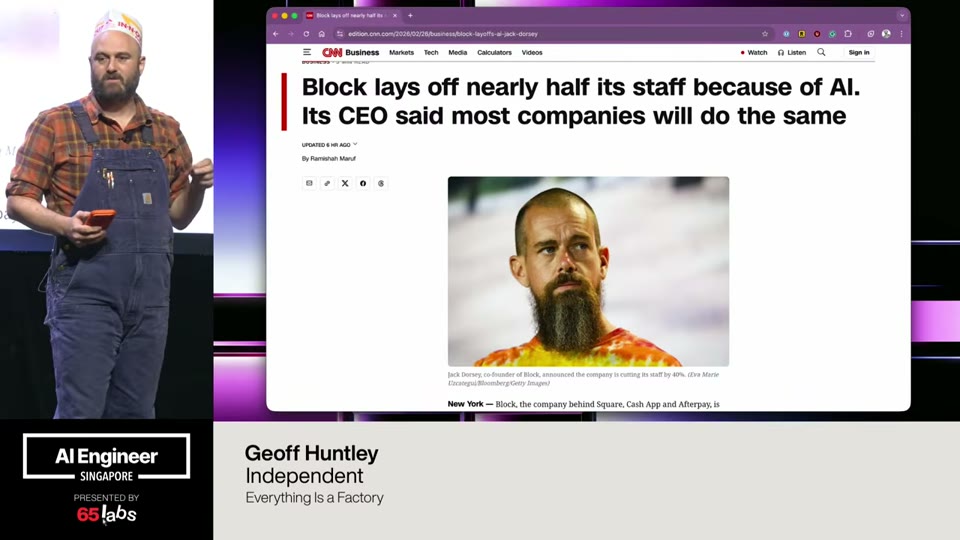
Geoff Huntley — independent AI researcher and originator of the REPL loop technique now embedded in many agent tools — argues that AI has ended knowledge scarcity, making "software development cost less than minimum wage" and forcing a J-curve transformation on every large organisation. He draws a sharp line between AI-native startups ("lean apex predators… hell yeah, I'm going to do AI-native workflows and not hire a lot of people") and incumbents still cargo-culting Spotify-style agile with thousands of employees, citing a New Zealand founder who cut from 60 to 20 people three years ago and "got more velocity than ever before" [02:05:25]. Huntley's hiring test is blunt: if a candidate can't draw a sequence diagram of inferencing or explain what a tool call is, they are not hireable in 2026. He frames the societal shock as arriving in lock-step with downtime periods like Christmas breaks, when people finally have space to discover how much the models have improved.
State of OpenClaw · Onur Solmaz & Vincent Koc, OpenClaw — 02:11:46 ·
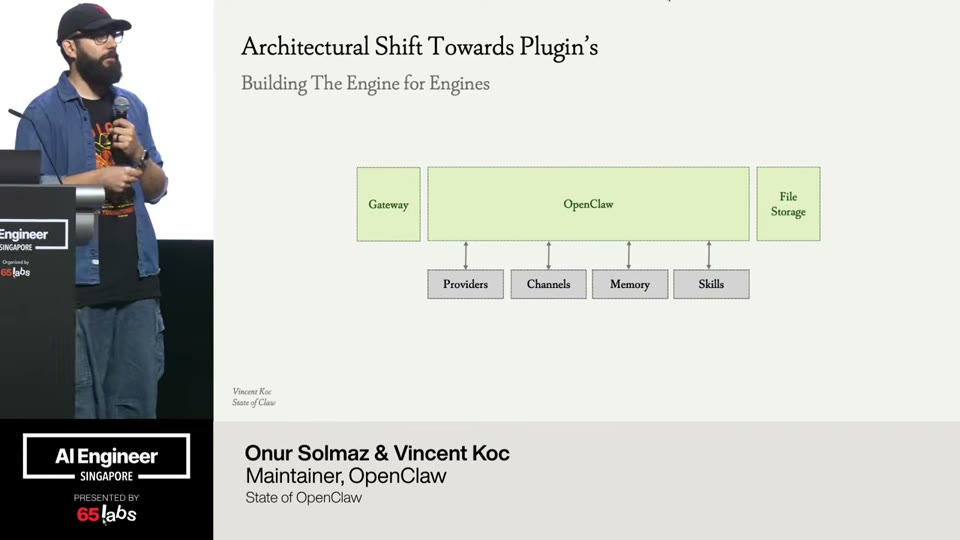
Vincent Koc, chief architect at the OpenClaw Foundation, reports the project has crossed 1 million npm downloads per week, 50,000 commits, 1,600 contributors and 80,000 forks, with 40 "ClawCons" held across six continents. The headline architectural shift is a hard plugin boundary: previously public internals were made private so the core can evolve without breaking the developer-facing extension API, and first-party harness support (e.g. the Codex harness for OpenAI models) is now delivered as a plugin rather than baked-in code. He demoed three new tools: Clownfish/Claw Sweeper — running harnesses inside GitHub Actions that cleared 10,000 PRs down to 3,000 in two days; git-crawl/disc-crawl — a Go CLI that ingests and clusters all issues/PRs into a distributed SQLite store refreshed hourly, accessible to agents for bulk triage; and Crabbox — a distributed gateway over Cloudflare and cloud spot-instances (Windows/Mac/Linux with VNC/SSH) so that a local Codex session can "spin up 10, 15, 20 of these boxes and start testing in great succession" [02:19:36] without burning local RAM.
AI Characters with Personality, Memory, and Human Inner Life · Vishnu (Vish) Hari, Ego AI — 02:22:28 ·
Vish Hari, founder of Y-Combinator-backed Ego AI (San Francisco / Tokyo), contends that every frontier lab is racing up an IQ roadmap while ignoring EQ — building "machine god slaves chained to always be nice to you" rather than AI with genuine opinions, desires, and personality. Ego trains an end-to-end foundation model for human-like affect and demonstrated a live character called Calcifer (a fire-sprite agent) that watches a user's screen, co-debugs Unreal Engine code collaboratively rather than just handing answers, and speaks with interruption and emotional cadence ("Calm down, Frankenstein" [02:25:39]). Hari described his personal vinyl-buying agent that receives a weekly $50 stipend, which it can lose if it recommends bad records — because "the character knows that if it goes below $0 in its stipend, it will die" [02:28:41], creating an incentive to learn his taste. The company is actively recruiting voice-data contributors in Singapore to train a naturalistically interruptive voice model.
Own Your Cloud: Personal Infrastructure Against Digital Feudalism · Ben Guo, Zo Computer — 02:31:53 ·
Ben Guo, co-founder of Zo Computer and ex-Stripe engineer (employee ~80, 2015), frames today's SaaS landscape as digital feudalism — "we are still peasants… the SaaS companies pay rent to the clouds who pay rent to the kings" [02:35:50] — and positions Zo as a personal cloud agent workspace that gives non-technical users root access to a well-provisioned VM they fully own. He cited Anthia, a free-diving instructor on track to make $100,000 via Zo's built-in Stripe payments after cancelling Squarespace, Calendly, ChatGPT, and Notion subscriptions. Zo supports any model, accepts input via text, email, Telegram, or Slack, and lets users host self-built replacements for SaaS tools (Guo showed custom Calendly, Last.fm, and Linear replacements where "I am the centre, not these SaaS companies" [02:39:52]). The broader thesis mirrors computing history: mainframes became personal computers, and cloud/software infrastructure should now become personal too.
Embedding Pi: The Minimal Coding-Agent Loop · Matthias Lubken, Tavon AI — 02:42:50 ⭐
Matthias Lubken, founder of Tavon AI (which builds safer agent-to-data pipelines under the brand "Databox"), gave a ground-up explainer on why Pi — a deliberately minimal coding agent by Mario from Vienna, shipping without MCP, sub-agents, permission pop-ups, plan mode, or built-in todos — is a better learning tool than OpenClaw precisely because of its simplicity. He live-demonstrated writing a Pi extension in one prompt that intercepts git push to main and asks for explicit confirmation, illustrating that the "missing" guard-rail features are user-composable rather than absent. The architectural lesson: a coding agent is "just tools in a loop with bash and a file system" [02:51:23], and Pi's extension API makes that loop transparent enough to embed as the "brain" inside a larger product gateway — his own Tavon system wires email as the input channel and CRM/ERP calls as the tools, with tool-call traces visible in the UI so operators can see exactly when and why the ERP was queried.
Design as the Competitive Edge in the Age of AI · Josh Newton, Microsoft AI — 02:56:27 ·
Josh Newton, principal product designer on Microsoft AI's health team and founder of the Flubin app studio, argues that AI raises the floor of software quality to "good enough" while leaving the ceiling untouched — making craft and taste the only remaining moat. His app Orbit (subscription tracker) reached six figures and three Apple features within a year not from novel functionality but from design obsession sparked by a mid-century poster on his apartment wall, illustrating that "AI is trained on everything that already exists… it returns the weighted average" [02:57:37] and cannot replicate lateral inspiration. Practically, Newton builds bespoke prototyping tools for every project (a custom shader tool for this talk's intro slide; a debug panel with data-richness sliders to simulate day-one vs. weeks-later states) and runs a personal OpenClaw agent he calls Flubbot to voice-dictate ideas while walking, auto-commit book research to git, and generate fast throwaway prototypes. The closing argument: "most of our time went into how to build, not what to build — that has flipped" [03:05:13], and no amount of AI will save a team that spends months building the wrong thing.
Patterns for Production AI Agents in TypeScript · Sam Bhagwat, Mastra — 03:07:04 ·
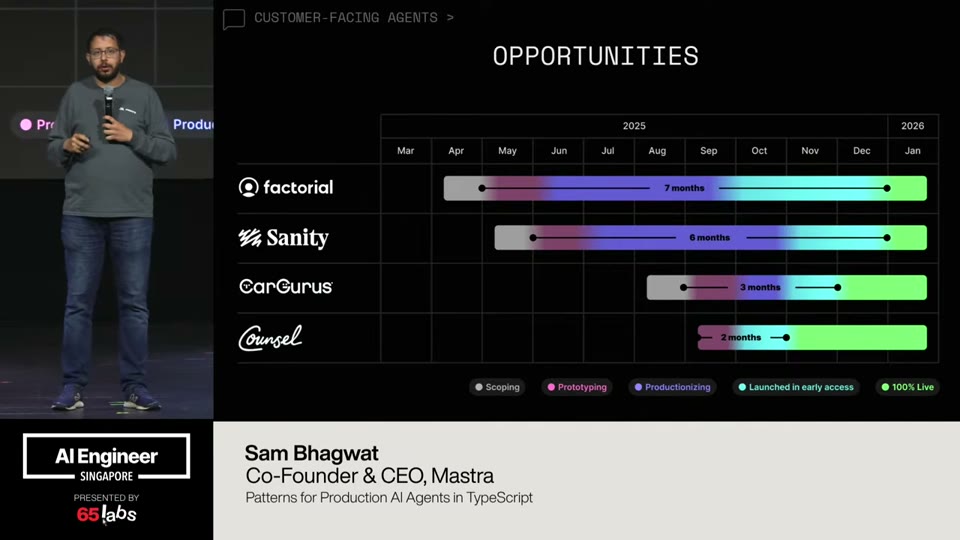
Sam Bhagwat, co-founder of Mastra (an open-source agent framework), distilled lessons from working with thousands of teams building agents into three categories: customer-facing agents (e.g., Indeed's career counselor that combines user resume data with proprietary salary/job data), internal agents (enterprise search, clinical-trial paperwork, RFP automation), and developer-platform agents (an AIOps SRE triaging Fortune 500 NOC alerts, agents parsing terabytes of CI logs). He argued that the fastest-shipping teams "can speedrun the idea maze" [03:14:21] because they have prior agent-building experience, and recommended using a framework like Mastra to avoid rebuilding primitives. A key tension he surfaced for customer-facing agents is per-user token costs reaching "hundreds or even thousands of dollars" [03:13:21], forcing teams to tune model choice, cost pass-through, and credit systems.
Parsing Billions of Docs: Production Failure Modes · Pierre-Loic Doulcet, LlamaIndex — 03:25:50 ·
Pierre-Loic Doulcet (name corrected from caption "Pierre") described running LlamaParse in production: over one billion documents processed, each through its own agentic loop combining vision-language models, OCR, and other techniques. He catalogued failure modes that rarely get discussed: whitespace loops where models (he specifically cited Anthropic's Sonnet class as "extremely sensible to that" [03:27:59]) emit infinite spaces that exhaust token budgets and cannot be stopped because space tokens cannot be set as stop sequences; model attention blindness where content between two repeated strings is silently ignored regardless of prompt changes; color blindness in vision models especially in the red spectrum, varying by model; and hallucination when templates have empty content, with Anthropic models tending to hallucinate "Delaware incorporation documents for some reason" [03:33:17]. For reliability at scale he built two open-source tools: an eval leaderboard hosted on Kaggle and Hugging Face, and LightParse, a CPU-based fallback doing ~500 pages/second for when LLMs fail.
Stop Asking Your Agent To Behave · Jun Yu Tan, Tusk — 03:38:09 ⭐⭐
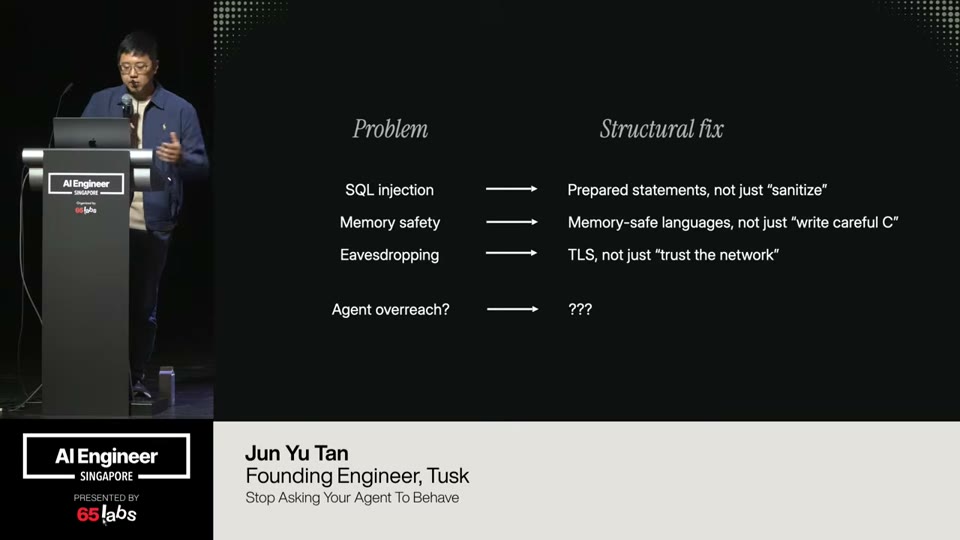
Jun Yu Tan (name corrected from caption "Junu") opened with a structural argument: just as SQL injection was fixed not by better input sanitization but by prepared statements, agent overreach should be fixed by moving enforcement below the layer where mistakes happen. Drawing on his own Cursor transcripts — median session 42 tool calls, average 120, longest over 1,000 — he showed that a 99%-reliable classifier has only a ~30% chance of zero errors across 120 calls, dropping to essentially zero at 1,000 calls: "probabilistic checks decay with scale; deterministic boundaries hold" [03:41:39]. Tusk's answer is Fence, an open-source, daemonless OS-level policy enforcer (no container runtime required) that restricts file-system paths, filters network calls through a local proxy, and blocks specified commands including chains and nested shells before execution. He framed agent safety as three stacked layers — classification (e.g., Claude Code's auto mode), policy enforcement (Fence), and isolation (containers/microVMs) — arguing most teams have only the outer two and should add the middle: "stop asking the actor to behave; let's change what the actor can do" [03:48:13].
Beyond Brute Force: The Era of Adaptive Intelligence · Sara Hooker, Adaption Labs — 05:01:45 ·
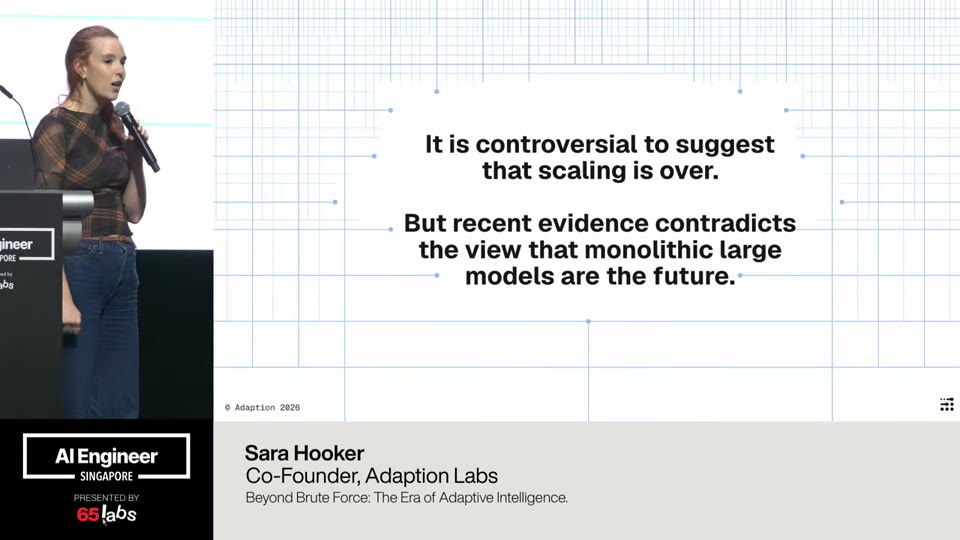
Sara Hooker, formerly of Google DeepMind and Cohere Labs, argued that the rate of return on scaling model size has inverted — "the latest efforts by Frontier Labs to triple, quadruple the size of their models have been seen as not servable and frankly kind of disappointing" [05:10:01] — and that most gains from scale are just learning rare long-tail artifacts at enormous cost. She positioned Adaption Labs around two pillars: adaptive data synthesis (released ~4 weeks prior, covering 242 languages, already processing 27 million data points) and "AutoScientist," released two days before the talk, a self-improving system that co-optimizes data and model training across ~30 architectures available on Together AI, able to train a frontier model in ~2 days. The core thesis: the new optimization space is the full stack from data through interface, not just model weights, and whoever makes the cost of real-time adaption cheapest will define the next era. AutoScientist was being offered free for one month at time of talk.
Agents That Schedule Their Own Compute · Vincent Wu, MiniMax — 05:17:28 ·
Vincent Wu (name corrected from caption "Vincent Lou") from MiniMax's API platform team made the case that long-running autonomous agents — unlike interactive pair-programming sessions — create genuine scheduling opportunities because latency stops mattering when agents work toward a deadline with a budget. The core insight is that different task phases (planning, implementation, GUI review) have radically different token profiles (cache-hit rates, output lengths), and if an inference provider knows a session's token profile in advance, it can match workloads to optimally configured hardware, maximize MFU, and smooth peak/off-peak GPU utilization. Wu sketched an "inference exchange" future where background agents submit session metadata — model, token profile — and are matched to the best available batch, analogous to a commodity market turning idle capacity into surplus for both providers and consumers. MiniMax is building toward this with the MiniMax CLI (mmx), currently a non-human-facing API client across their speech, image, video-gen, and LLM model range, intended to evolve into a full autonomous compute-scheduling interface.
Teleoperated Robots as the Data Engine for Autonomy · Daniel & Siddharth Krishnan, The Robot Company — 05:29:44 ·
Daniel and Siddharth Krishnan (name corrected from caption "Sad") of The Robot Company argued that the "autonomy gap" — the chasm between 80% lab evals and production-ready robotics — can only be closed with real-world embodiment data collected by teleoperated robots doing actual commercial work today. They deploy in insect farms, laundry facilities, food prep, and hospitality; operator onboarding is hard (only 30–40% of ~100 trained operators passed), and hardware and environment variance are brutal. Their thesis mirrors the LLM playbook — pre-training, SFT, RLHF all depend on high-quality data that is "a byproduct of real useful work done" [05:35:17] — so teleoperation as a deployment layer generates the highest-quality embodiment data (morphology, environment, and task all match). The solution to the one-to-one scaling ceiling is telesupervision: scaling to one-to-many interventions plus cross-border remote teleoperation; they demonstrated a Singapore-to-London live demo with sub-100 ms latency on their own stack.
BCI Painting and Embodied Creative Agency · Justin Baird, Tesseract with Kai Ming — 05:41:06 ·
Justin Baird of Tesseract presented a live demonstration of Tesseract.art, a system combining a robot arm ("Tessa"), multimodal AI, and a Muse EEG headband to let Kai Ming — who has Alist Syndrome (Rett Disorders, corrected from caption) and has lost fine motor control — paint using brain signals. The painting completed on stage depicted Hope, a two-fingered sloth at the Singapore Zoo and mascot of the Rare Disorders Society of Singapore. Baird framed the project as "shared autonomy": human creative intent expressed through brain-computer interface, AI translating that intent, robot executing it — the inverse of the dominant AI-takes-jobs narrative. He pointed to an existing avatar-robot café in Japan where bedridden people operate customer-serving robots remotely as evidence that this model already creates real employment for people with disabilities, arguing the BCI-plus-AI stack could open an entirely new workforce: "we need a human in the loop… if you can think about AI being something that is providing the opportunity to do something" [05:51:48].
Sim-Generated Worlds for Robotics Evals · Aravind Kandiah, Bifrost — 05:55:52 ·
Kandiah argues that the "robotics development gap" — strong lab performance collapsing in real deployment — stems from out-of-distribution scenarios never covered by real-world data collection, which he calls "empty calories" for training. Bifrost's approach generates entire domain-specific simulation worlds from real data ("you can take in real data and generate things from that real data and then re-simulate the world") enabling parameter sweeps across thousands of lighting conditions, spatial layouts, and dynamic elements simultaneously. By running AI models against this simulated coverage first and then directing real-world testing only at simulation failures, teams can close the sim-to-real gap without scaling linearly with robot-hours. At [05:58:18] he crystallizes the need: "What you need is more edge case scenarios — it's like a cow crossing a complicated intersection, a plastic bag right in front of the rear view mirror."
Sensorizing Humans for Humanoid Training Data · Julia Kim, OpenGraph Labs — 06:10:11 ·
Kim argues that video-based egocentric data alone — already validated by Nvidia's EgoScale research for pre-training humanoid policies — is still insufficient because it lacks touch, the most critical modality for physical intelligence. Infants learn through sensorimotor loops: grasping, pressing, tasting; if robots are to share our world they must learn the same way. OpenGraph Labs is building a standardized hardware-and-encoder stack for fingertip tactile data, analogous to how the RGB camera became the universal platform for computer vision: "We need a unified hardware stack that everyone could build on for touch data and also build a data infrastructure which shares the same format." Their pipeline targets millions of human interaction moments — every point of contact between hand and object — digitized and ready as training data for the next generation of humanoids.
Full-Stack Robotics Data Operations · Suveen Ellawela, Cortex AI — 06:19:44 ⭐
Ellawela describes Cortex AI's role collecting over 700 hours of bimanual robot data for the Allen Institute for AI's MimicAct 2 paper — the largest open bimanual dataset to date — and the operational lessons learned scaling teleoperation to hundreds of hours. A key insight is "breadth": the problem layer and solution layer rarely match, illustrated by a gripper failure that turned out to need a hardware redesign rather than a software fix, and a camera-view drift bug solved by a pre-session software check rather than a rigid mount. He closes with a candid safety section: joints can snap 90° in under half a second; test tube shards fly; stale action queues cause sudden arm movements. On AI-written code for robots, his team runs it through simulation logs and single-joint slowed tests before any live execution — [06:28:32] "we try to check in simulation and we try to test in logs... just look at the logs first."
Design Craft That AI Cannot Automate · Jay Demetillo — 06:57:36 ·
Demetillo, drawing on his time shipping Canva's AI-powered spreadsheet to millions of users, argues that AI is an intern, not an art director, and that "prompt fatigue" from token-maxing leads to sloppy products. He invokes the IKEA effect and the 1947 Betty Crocker cake-mix story to show that users invest in products when AI acts as a collaborator with a human choice point, not a one-shot replacement. Real design craft — the kind that required 5,127 Dyson vacuum prototypes or Apple's keyboard team iterating in front of Steve Jobs — demands testing with real users outside the tech bubble, because "AI builds the happy path; humans break it, they don't care." His closing provocation at [07:06:58]: "Be anti-bullshit. Be AI fluent, just be anti-bullshit."
AI-Native Design Systems for Brand-Faithful UI · Alex Lee, Magic Patterns — 07:09:54 ·
Lee argues that the proliferation of AI coding agents has recreated the "wild west" chaos that design systems were invented to tame: agents hallucinate colors, invent components, and drift from brand guidelines without context. Magic Patterns' answer is an "AI-native design system" with two pillars — documentation and code (tokens, component props, and Storybook stories) — which gives agents the context to produce brand-faithful output. A live comparison for Headway, a mental health platform, showed the same "build me a dashboard" prompt producing a generic SaaS layout without the design system versus a pixel-close brand match with it. The workflow now closes the loop via MCP: design prototypes are code-backed using the real component library, so engineers can round-trip between prototype and production codebase with no manual Figma translation.
No-Gatekeeping Design for Engineers · Sabina Cabrera, MagicPath — 07:20:02 ·
Cabrera, a designer at MagicPath, reframed her talk the morning of delivery specifically for an engineering audience and delivered a rapid-fire design literacy crash course — serif vs. sans-serif vs. mono typography, shader tools like Unicorn Studio, and hero animations via prompted codebases — arguing engineers already have taste and should stop treating design as a black box. Her thesis is that design tools must meet creators wherever they are: half-baked Next.js apps, Figma files, or a product manager's verbal description, all valid starting points. MagicPath (launched multi-agent enterprise collaboration two days before the talk) lets teams run designs through external agents like Claude Code or CodeX, maintain a clean canonical file, and share live-link outputs over Slack — closing the loop between design and code without locking anyone into a single tool.
Layered Editability and Design Intelligence · Priyaa Kalyanaraman, Lica World — 07:34:01 ·
Kalyanaraman, co-founder of Lica World (caption: "Leica"), argues that frontier image-generation models fail at graphic design because they output frozen flat files — every prompt resets design state, layers are unexposed, and text is a lossy interface. Lica's approach isolates compositions into semantic layers, enabling localized edits without destroying the rest of the design and allowing different specialized models (SVG, photo, text) to be routed per-layer. To address the data gap — Figma, Canva, and Adobe hold billions of editing traces and share none — Lica collected 1.5 million layered graphic design compositions across 50+ categories, parts of which are open-sourced on Hugging Face. Their multi-signal reward system pairs human preference labels with objective design-quality rewards, feeding an AI judge that continuously refines its rubric and retrains the generator: "design has a shelf life and you constantly want to expose really good examples."
The Company Brain: Agents Need a Source of Truth · Conor Brennan-Burke, Hyperspell — 07:44:55 ·
Brennan-Burke argues that RAG connectors alone fail because "connections give access, they don't give understanding" [07:47:57] — documents are lagging indicators that diverge from reality the moment they're written. Hyperspell builds a "context graph" that deduplicates entities across Slack, Gmail, Notion, and GitHub, resolves conflicts by surfacing them to humans, and then serializes everything as a file system that coding agents like Claude Code and Cursor can natively consume. Critically, agent-generated context — prompts, execution traces, Claude Code reasoning loops — is treated as a first-class input alongside human-authored docs. The end state is an organization that improves recursively: every agent run synthesizes new learnings back into the brain, preventing the "context drain" that happens when people leave.
Plan, Preview, Orchestrate: Cloud Coding Agent Primitives · Heng Hong Lee, Lightsprint — 07:56:35 ·
Lee (company name is "Lightsprint," transcribed as "Lightprint"/"Lightream" in captions) presents three primitives for cloud coding agents: plan, orchestrate, and preview. The Lightsprint platform is a Kanban-style workbench where tasks are enriched with codebase context and then fired off to agents — supporting Cursor, Anthropic, and Codex as underlying harnesses. The live demo shows a visual plan wizard that generates multiple UI mock options for the agent to choose from before producing a full spec, then hands off to a background agent; once the PR is ready, teammates can interactively preview the running app before review. Lee reports their own team ships mobile bugs and small features entirely via cloud agents, achieving significant parallelism with no local setup required.
All We're Going To Do Is Plan and Review · Louis Knight-Webb, Vibe Kanban — 08:07:51 ·
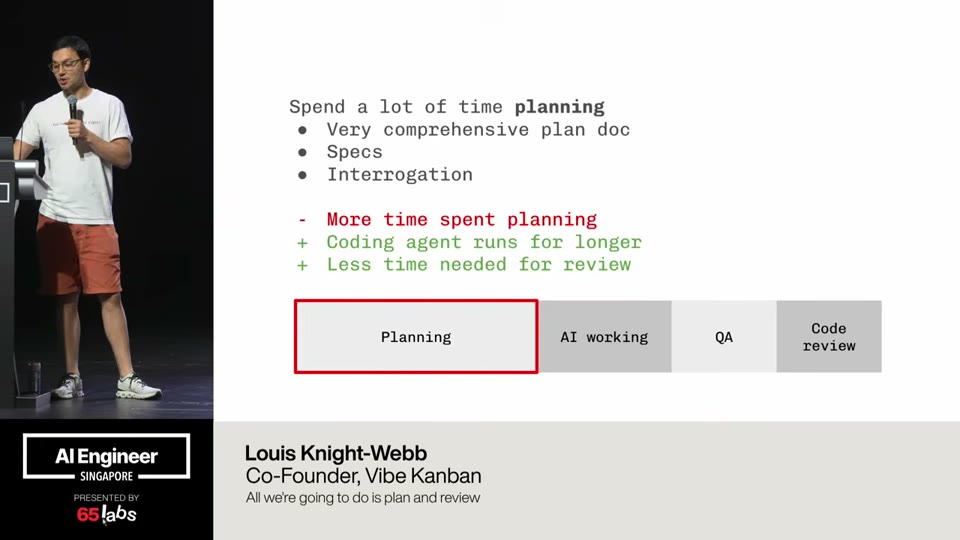
Knight-Webb describes building — and then shutting down — Vibe Kanban, a Kanban board where each ticket has a play button to launch it in Claude Code, Codex, or six other agents, with a built-in review UI for code inspection and live app testing. His central argument is a historical arc: from GitHub Copilot (seconds of compute, 2021) through Cursor (30 seconds, 2024) to Claude Code (5+ minutes average today), and predicts agents running 30 minutes within a year, making parallel orchestration essential. "If you spend five minutes planning, you will probably save yourself a lot of time reviewing" [08:15:08] — he distinguishes planning-heavy backend work (parallelizable) from review-heavy frontend work (more human-in-the-loop). He shut the company down noting the space moved faster than the business could, offering it as a "lesson" for founders in the room.
Deterministic Multimodal Tasks with Encoder–Decoder Architecture · Harsha Khurdula, Interfaze AI — 08:19:42 ·
Khurdula (company spelled "Interfaze AI," transcribed as "Interface") argues that transformer LLMs hallucinate on deterministic tasks — tasks with exactly one correct output — because of context drift at large inputs. Interfaze's solution pairs specialized ML encoders (a CNN stack for OCR bounding boxes, a contrastive segmentation model for natural-language object detection, and a spectogram-based ASR encoder) with an LLM decoder conditioned on the encoder's structured output. Live demos show Interfaze outperforming Reducto on document OCR with pixel-level bounding boxes and age calculation, and beating Claude Opus 4.7 (which timed out all three attempts) on dense PDF translation to Hindi with exact character counts. Interfaze claims the top rank on M-OCR-Bench and on natural-language object detection benchmarks versus specialized providers.
High-Context Agent Runtimes for Legacy Systems · Hrishi Olickel, Southbridge — 08:31:07 ⭐⭐
Olickel (company is "Southbridge") presents lessons from building ETL and data-ingest agents for healthcare, finance, and energy — systems where reliability from day one is non-negotiable. His core primitives: break work into small, reusable "codons" chained in the Hanqku runtime (recently open-sourced); actively delete context rather than accumulate it to prevent "world line rot"; separate data, prompts, control flow, and code as rigorously as MVC. The talk's most distinctive concept is sentinels — lightweight LLM calls that trigger on events from the primary agent loop (e.g., every 50 tool calls), summarize state to a file, and detect behavioral drift like laziness or bad data hygiene without adding orchestration complexity. For cost control, Southbridge uses a declarative budget system where money, tokens, time, and data-access limits are expressed at build time, and the runtime solves the allocation gap — "declarative actually wins because it keeps you from needing to rewrite things" [08:40:20]. He argues a single primary agentic thread with sentinels beats parallel agents for their reliability-first workloads.
Give Agents Agency · Henry Mao, Smithery — 08:44:30 ⭐⭐
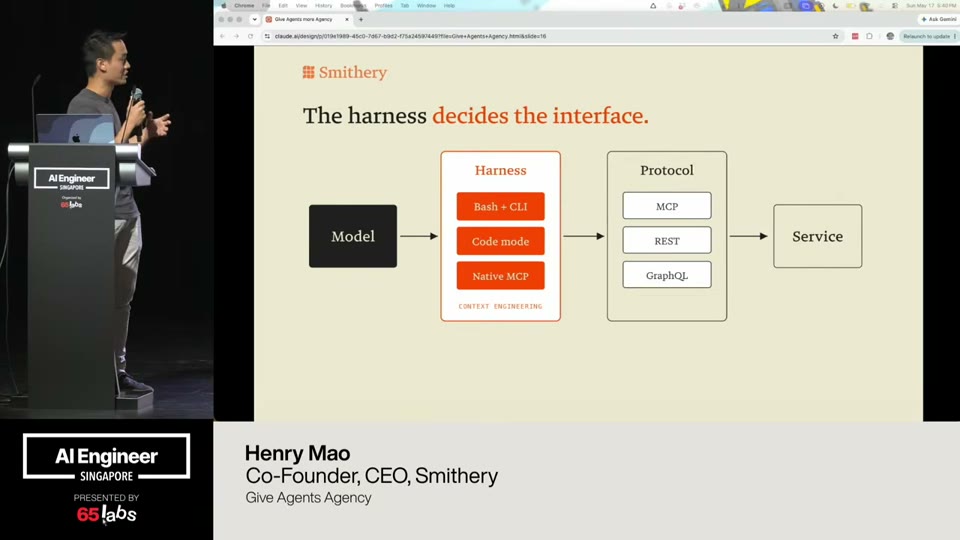
Mao founded Smithery as an open MCP registry and gateway (currently processing ~100,000 tool calls per day) and ran a benchmark comparing native MCP rendering against CLI/Bash across GitHub, Linear, and the Singapore bus API on three models. Contrary to prevailing skepticism, native MCP won on both accuracy and token efficiency in 2026 — because major harnesses like Claude Code and Codex now implement proper MCP rendering rather than dumping all tool schemas raw into context. The key design principles that explain the gap: self-documentation (well-described discoverable tools) and search (letting agents search subcommands/tools rather than exhaustively enumerating them). Mao's most pointed security argument: CLIs "give the keys to your kingdom" and force a choice between approval bottlenecks and skipping permissions, whereas MCP's narrow surface enables a policy DSL — Smithery's gateway offers fine-grained permission guardrails — making it the safer foundation as agents graduate to full autonomy.
Self-Evolving Agent Harnesses and Code Intelligence Tools · Rach Pradhan, Independent — 08:56:30 ·
Pradhan (introduced as "Raj," full name Rach Pradhan) presents a research-to-production arc inspired by open-endedness literature (OmniEpic, self-evolving code agents) and biological entropy gradients: the harness is the selection pressure, and tools plus environments are the levers to improve agent performance. He built a suite of self-use tools: muanry (faster ripgrep for agents), CodeDB (trigram search returning exact lines needing change to reduce context rot), nanobrew (dependency resolver faster than apt-get and Homebrew for snapshotting agent sandboxes), an accessibility-tree browser agent using Chrome DevTools Protocol with lower token consumption, and DevSwarm — a multi-agent orchestrator mixing Opus context windows and GPT windows with a rigid terminal-bench source of truth that rewrites the harness fitness function from telemetry. CodeGraph, the resulting self-evolving harness, was briefly SOTA on terminal-bench and is fully open-sourced including its reasoning trajectories, which Pradhan argues are "the artifact worth studying" — not the weights.